When I first saw the news that the luggage storage platform Bounce was officially expanding in Japan, my honest reaction was simple:
“This could get interesting.”
The reason is not Bounce itself.
It’s the timing.
Japan already has a homegrown luggage storage service that many travelers rely on: ecbo cloak.
It has quietly become part of Japan’s travel infrastructure—especially around major stations and tourist areas.
So when a global player like Bounce, operating in thousands of cities worldwide, enters the same market, the obvious question isn’t who is bigger.
It’s this:
Which one actually works better for traveling in Japan?
As of 2025, Bounce claims over 5,000 locations across 650+ cities in Japan, on top of its global network.
On paper, the scale and track record are hard to argue with.
In this article, I’ll focus on one practical question:
If you’re traveling in Japan right now, which is more useful—ecbo cloak or Bounce?
Rather than listing features in isolation, we’ll compare how both services actually perform in real travel situations, where expectations from overseas don’t always survive first contact with Japan.
1. Which One Actually Works? — The Short Answer
Both ecbo cloak and Bounce are usable luggage storage services for traveling in Japan.
However, they fit different types of itineraries.
Before diving into detailed feature comparisons, it helps to start with a simple question:
In what kind of trip does each service make the most sense?
When ecbo cloak is the more rational choice
Trips centered around major stations and well-known tourist areas
ecbo cloak works particularly well for itineraries that revolve around major stations and classic sightseeing spots.
In large cities such as Tokyo, Osaka, and Kyoto, it fits naturally into typical tourist routes.
If your plan is to leave your luggage near a station and explore the surrounding area,
ecbo cloak aligns well with the most common way people move through Japanese cities.
When Bounce is the more rational choice
Trips that include residential areas or local shopping streets rather than major tourist zones
Bounce has partner locations not only in major sightseeing districts but also in areas closer to everyday residential neighborhoods.
For itineraries that go beyond standard tourist routes, it can become a practical option.
Trips where you want to complete reservations and payment before arriving in Japan
Bounce also works well for travelers who prefer to settle logistics in advance.
If you want luggage storage to be something you decide and pay for during the planning stage—rather than on the spot—Bounce tends to fit that approach better.
This section outlines the practical conclusion of the comparison.
In the next chapter, we’ll look more closely at why these differences appear,
focusing on location distribution, reservation flow, and service design in more detail.
2. Detailed Comparison
2-1. Why “Tourist Areas” vs. “Local Neighborhoods” Change Which Service Makes More Sense
When choosing between ecbo cloak and Bounce,
the single biggest dividing line is what kind of areas your trip mainly covers.
When you search the same locations in both apps
(as of December 18, 2025),
a clear difference emerges in how storage locations are distributed.
Let’s start with a classic tourist destination:
Asakusa (around Sensō-ji Temple).
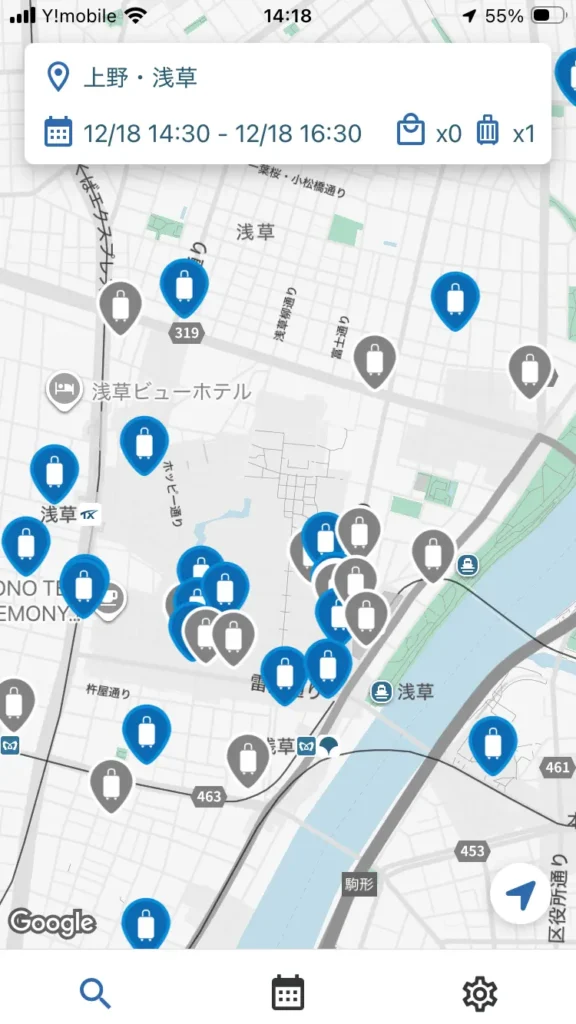
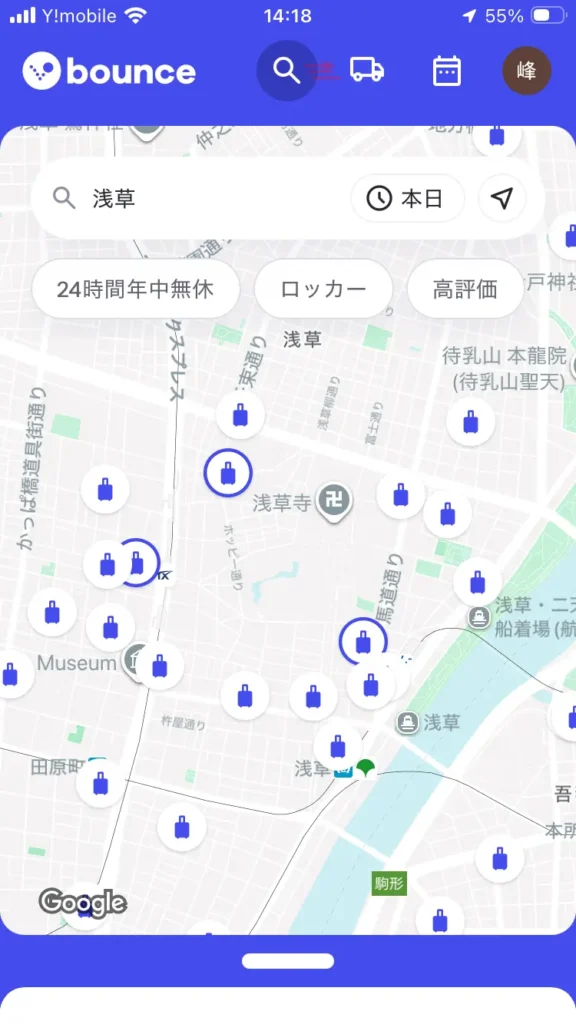
In this area, ecbo cloak clearly shows more locations.
In terms of sheer numbers, the difference is roughly about 1.5×.
Beyond the numbers, the type of locations also matters.
ecbo cloak actively places storage points in places such as:
- Inside stations or station-connected buildings
- Cafés directly in front of major stations
- Tourist information centers and facilities along sightseeing routes
This makes ecbo cloak extremely well aligned with typical sightseeing itineraries,
where travelers move on foot between stations and major attractions.
At least for the use case of
“leaving your luggage near a famous sightseeing spot,”
it is natural for ecbo cloak to appear clearly advantageous here.
Next, let’s look at a more residential area slightly removed from major tourist routes:
Musashi-Kosugi Station
(an area that is primarily residential, but also functions as a calm commercial district).
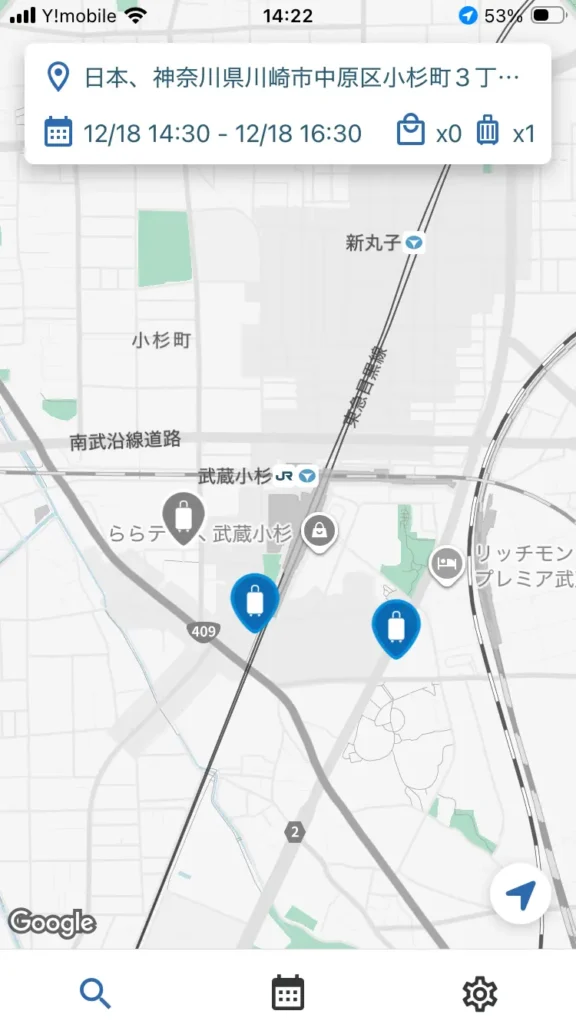
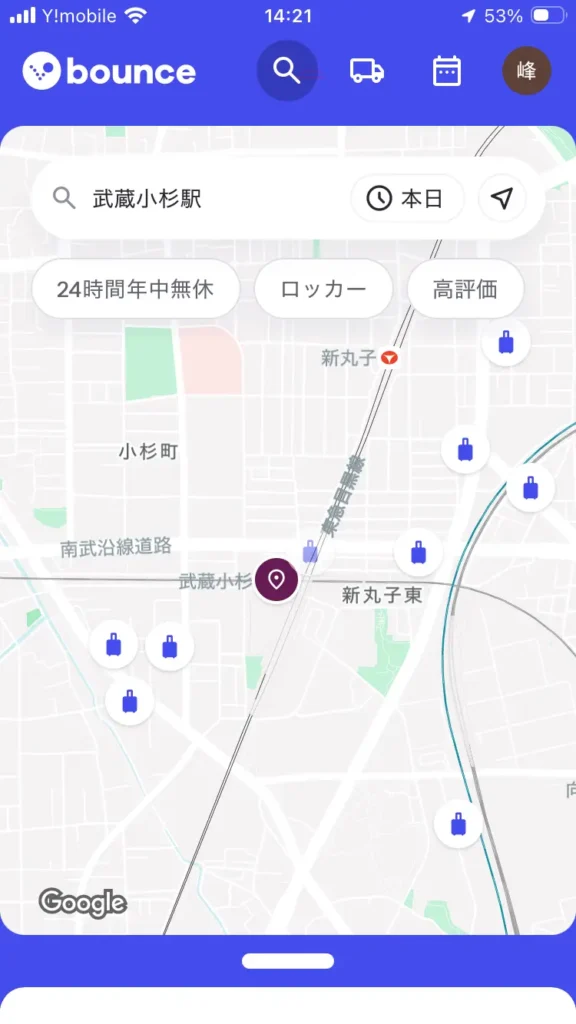
Here, the picture flips.
Bounce shows a larger number of available locations.
Bounce’s partner locations include a wider variety of businesses, such as:
- Karaoke venues
- Small retail shops
- Hotels
- Some dedicated locker facilities
Because of this diversity, Bounce tends to surface more options outside of classic tourist zones,
including areas that are closer to everyday residential neighborhoods.
That said, for many travelers reading this article,
storing luggage in a non-tourist residential area may not be the main scenario they have in mind.
Based on this comparison alone,
it is easy to come away with the impression that ecbo cloak holds a clear advantage:
- Higher concentration of locations in tourist areas
- Better alignment with standard sightseeing routes
In fact, if your mental image of luggage storage in Japan is
“drop bags near a famous attraction and keep exploring,”
ecbo cloak likely feels like the obvious winner at this stage.
2-2. Why Bounce Works Better with Advance Reservations
Next, let’s look at how each service performs during the planning stage of a trip.
Both ecbo cloak and Bounce allow advance reservations.
At first glance, this makes them appear largely similar in terms of booking convenience.
However, if there is one factor that matters most when placing a reservation in advance,
it is what happens if your plans change.
The Decisive Difference: Same-Day Cancellations
With Bounce, cancellations are allowed up to shortly before the scheduled drop-off time
(often up to one hour in advance).
If the conditions are met, the reservation is refunded or converted into credits.
By contrast, ecbo cloak generally does not allow refunds for same-day cancellations.
If plans change on the day of use, the reservation simply expires.
In real travel situations, uncertainty is unavoidable:
- Flight delays
- Lengthy immigration procedures
- Changes in arrival time
- Same-day itinerary adjustments
When these factors are taken into account,
whether a reservation can be canceled at the last minute or not becomes a critical consideration.
From this perspective,
Bounce has a clear advantage when it comes to making advance reservations.
2-3. Additional (Optional) Advantages of Bounce
There are a few additional points worth noting as supplementary information.
An App Designed Primarily in English
Bounce’s app and service explanations are designed with English as the primary language.
By contrast, ecbo cloak is built on a Japanese-language app with multilingual support added on top.
Because of this difference,
travelers from English-speaking countries may find Bounce’s wording and navigation
to feel more natural and less culturally specific in some cases.
Airport-to-Delivery Option
Bounce also offers an option to drop off luggage at the airport
and have it delivered to a Yamato Transport location.
This creates a use case that ecbo cloak does not currently support:
handling luggage directly at the airport and sending it onward into the city.
That said, it is important to note that airport pickup is not available at this time.
This option should be viewed as a supplementary convenience rather than a core feature.
2-4. What You Can (and Can’t) Do — A Practical Comparison
The table below summarizes how ecbo cloak and Bounce compare across major decision points.
This is not a checklist of “features,”
but a way to confirm where meaningful differences exist — and where they don’t.
| Aspect | ecbo cloak | Bounce |
|---|---|---|
| Major tourist areas | ✓ Strong presence | ✓ Limited |
| Residential / local areas | ✓ Limited | ✓ Wider coverage |
| Advance reservations | ✓ Available | ✓ Available |
| Same-day cancellation | × Not refundable | ✓ Refund or credit (conditions apply) |
| English-first design | ✓ Translated from Japanese | ✓ Designed in English |
| Airport handling | × Not supported | ✓ Airport → delivery option |
| Pricing level | Similar | Similar |
| Basic usage flow | No major difference | No major difference |
Legend
- ✓ = Particularly well suited
- ✓ = Generally available / usable
- × = Not supported
How to Read This Table
A few points are worth emphasizing:
- Both services cover the basics equally well
(reservations, payment, and standard luggage storage). - The decisive differences are limited to:
- location distribution
- same-day cancellation policy
- optional airport handling
- Outside of these areas, there is no clear superiority between the two.
Practical note (account setup):
Some travelers report issues during ecbo cloak registration,
particularly with SMS verification codes not arriving.
This can happen if you are using a data-only SIM,
and there are also reports of occasional issues with eSIMs.
To avoid unnecessary friction at signup,
using a social login option (such as Google sign-in) is generally the most reliable choice.
3. Competitors and Alternatives
ecbo cloak and Bounce are not the only ways to store luggage in Japan.
There are several alternative options and competing services travelers may encounter.
Common examples include:
- Radical Storage (and other global luggage storage apps)
- Coin lockers at stations or around the city
- Hotel luggage storage
That said, when it comes to actual adoption and visibility in Japan,
ecbo cloak stands clearly at the top, with Bounce following behind.
Other global luggage storage apps exist, but there is a noticeable gap in both presence and practical usability.
As for coin lockers and hotel storage,
they can be very convenient if everything lines up perfectly.
However, availability, size limits, and usage conditions make them less reliable,
and they are difficult to treat as full replacements for app-based luggage storage.
For this reason, when travelers realistically ask themselves
“Which luggage storage service should I use in Japan?”,
the decision usually comes down to ecbo cloak or Bounce.
If you’re interested in what to do when coin lockers and apps both fail,
we cover the full range of fallback options in a separate article below:
Coin Lockers Are Full. Now What?
4. Conclusion
Throughout this article, ecbo cloak and Bounce have been compared as if they were a simple either-or choice.
In reality, using luggage storage in Japan is rarely that binary.
In most cases, a more practical approach is to
check ecbo cloak first, and if nothing fits, open Bounce next
—or do the reverse, depending on the situation.
This article is best used as a guide for deciding
which service to treat as your first option,
rather than as a strict recommendation to choose only one.
It’s also worth remembering that, in real travel situations,
there will be areas where neither service has available locations.
Instead of relying on apps alone, travelers should stay flexible and consider other options when needed—
using coin lockers, asking hotels about luggage storage,
or even shifting to a nearby station to widen the search area.
How you handle your luggage can have a surprisingly large impact on your trip.
Combining multiple options and adapting to the situation on the ground
is often the most realistic—and least stressful—way to travel in Japan.
Authentic Japanese Souvenirs, Delivered
- Hotel delivery (no international shipping fees)
- Order before or during your trip and receive everything at your hotel
- Plan ahead and start sightseeing hands-free from day one
- Save time
- No more arriving in Japan only to find the souvenirs you wanted are sold out
- Skip the souvenir hunt and spend more time enjoying your trip
- All items are made in Japan
- Forget the worry of “Is this really made in Japan?”
- Every item is carefully selected and genuinely Japanese-made