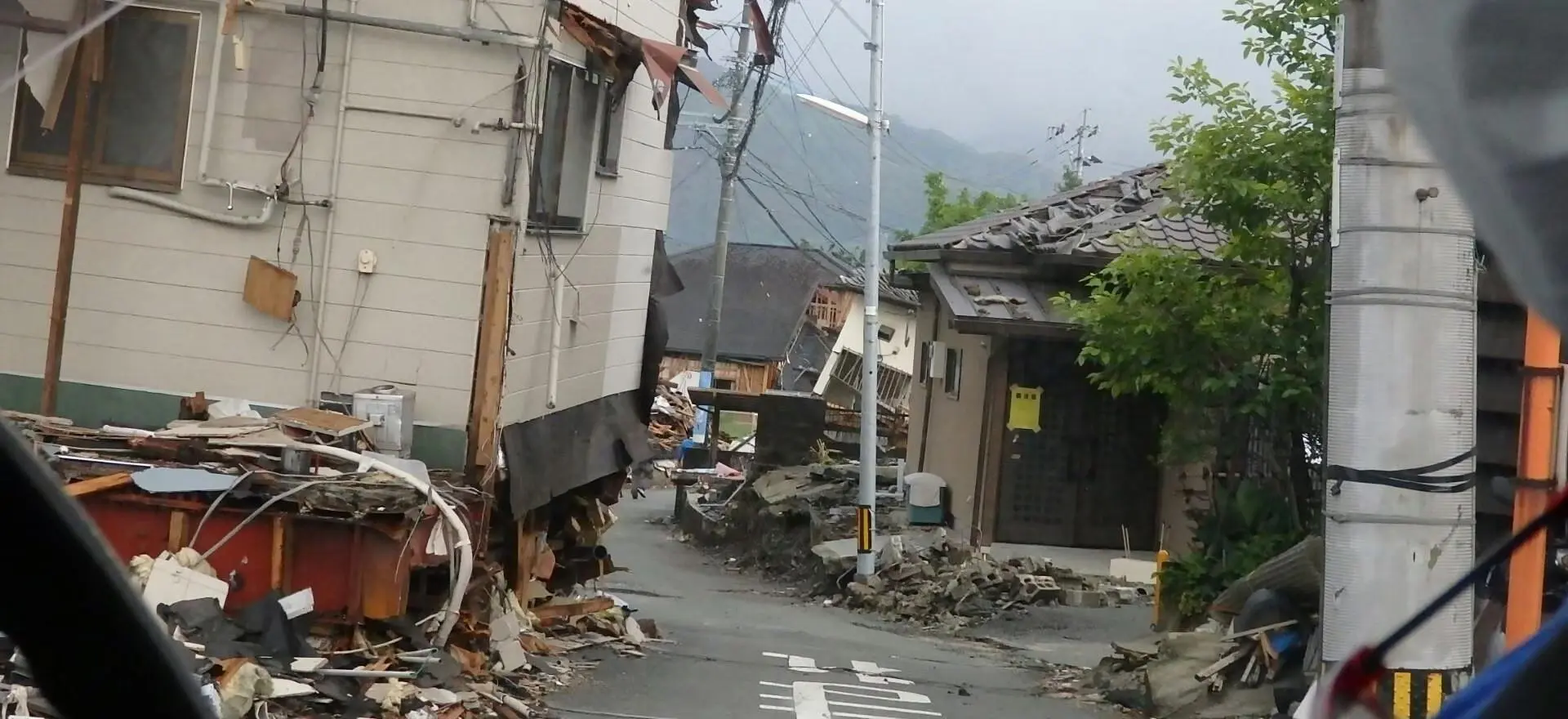
Japan is widely known as a country with an extremely high number of earthquakes.
Thousands occur every year, and even if we narrow that down to earthquakes strong enough to be clearly felt—Shindo 3 or higher—the annual count still reaches somewhere between one hundred and several hundred.
For travelers staying in Japan, the chance of actually feeling a building shake is far from rare.
Perhaps you came across this page after learning that fact and started wondering:
“How should I prepare if an earthquake happens?”
In many travel blogs, you will see various disaster-related apps introduced, often followed by an explanation like this:
“Japan’s disaster preparedness is highly advanced, so you’ll be fine.”
But is that really true?
When an earthquake actually happens, many foreign travelers become confused.
And I believe the reason is this:
They cannot tell
whether they should take action,
or whether this is a situation where no action is needed.
In reality, most earthquakes in Japan fall into the latter category—no action is required.
The shaking stops, and within a few minutes, everyday life resumes.
This is not unusual at all.
The real problem is knowing when that changes.
In other words, the point at which
“no action is needed”
turns into
“action is required”
is extremely difficult for travelers to see.
This article is not about panic responses or evacuation manuals.
Its purpose is to show—clearly and from a traveler’s perspective—the boundary between earthquakes that require no action and those that demand immediate action.
Once that boundary becomes clear, encountering an earthquake in Japan no longer needs to be an unnecessarily frightening experience.

1. Most Earthquakes in Japan Do Not Require Action
Most earthquakes that occur in Japan are ones that do not require any action.
At the moment they feel the shaking, the first thing most Japanese people do is not to rush outside or head to an evacuation shelter.
In many cases, they simply stay where they are and wait for the shaking to stop.
And once the shaking has ended, if there is no noticeable change in the surrounding situation, daily life continues as if nothing had happened.
It would be dishonest to deny that this response is partly influenced by a form of normalcy bias that has developed through repeated exposure to earthquakes.
Even so, Japanese people have learned through experience to distinguish, at least to some extent, between
earthquakes that require action and those that do not.
Only after understanding this basic premise does it make sense to move on to the next question:
So then, what kind of earthquakes actually require action?
2. Shindo as a Practical Reference for Deciding Whether Action Is Needed
In Japan, earthquake information focuses not on magnitude, but on Shindo.
Shindo does not represent the overall size of an earthquake.
Instead, it indicates how strongly the ground actually shook at a specific location.
For this reason, when an earthquake occurs, what people pay attention to most is
“Where was it, and what was the Shindo there?”
This information is broadcast as breaking news across all TV channels.
As a result, when Japanese people feel a noticeably strong shake, their first reaction is often to turn on the television.
In guides written for travelers, the Shindo scale itself and its numerical definitions are often explained in detail.
However, what most people really want to know is something more practical:
“From around what Shindo level does action start to become necessary?”
Before going further, one point must be made clear.
Shindo is not an absolute rule that tells you when to act.
Still, in many situations, it serves as a realistic reference for considering
whether the likelihood of action being required is increasing or not.
Shindo 1–3: Action Is Rarely Needed
At Shindo levels 1 through 3, some people may feel nothing at all, while others may simply think,
“Did it just shake?”
At this level, Japanese people almost never take any special action.
Shops and transportation continue operating as usual, and there is little noticeable change in how people around you behave.
For travelers as well, it is generally safe to assume that no action is required.
Shindo 4: The Shaking Is Clear, but Waiting Is Often Enough
At Shindo 4, nearly everyone can clearly feel buildings shaking.
Objects on shelves may move slightly, and more people begin to feel uneasy.
Even so, in most cases, Japanese people still choose to wait and observe.
If the shaking stops and there is no visible change to the building or the surrounding situation,
they do not immediately take action.
At this stage, the decision to do nothing is still the most common outcome.
Shindo 5: The Line Where Action Starts to Be Seriously Considered
From Shindo 5– (lower 5) to Shindo 5+ (upper 5), the situation changes noticeably.
In addition to the stronger shaking, objects may fall, and facilities or transportation systems may temporarily stop operating.
At this level, even Japanese people pause to reassess the situation—
sometimes moving to a place that seems safer—
and begin carefully considering what to do next.
For travelers as well, this is the Shindo range where the need for action should be seriously considered.
Shindo 6 and Above: Stop Making Individual Decisions and Follow Local Judgement
Once the shaking reaches Shindo 6 or higher, there is a high likelihood that some form of damage has occurred.
At this point, deciding how to act based solely on personal judgement can be dangerous.
Instructions from facilities, the actions of people around you, and guidance from hotel staff or station employees should take priority in ensuring your safety.
What Matters More Than the Numbers
The Shindo levels discussed above are only references for thinking about action.
Even at the same Shindo level, what action is appropriate can vary depending on where you are, the type of building you are in, and what is happening around you.
That is why what truly matters is not the Shindo number itself, but whether action is necessary after the shaking, based on the situation around you.
In the next chapter, we will organize the specific signs you should pay attention to when making that decision.
3. The Sign That Tells You When to Take Action
What “action” means in this article
In this article, the word “action” refers to movements that involve a decision to interrupt or change the normal flow of events, such as evacuation or relocation.
For example, deciding whether to leave a building or stay inside, choosing whether to remain where you are or move to another place, canceling a planned train ride and selecting an alternative, or deciding whether to return to your hotel—all of these overturn the assumption that “everything can continue as usual.”
On the other hand, stopping to wait for the shaking to end, checking your surroundings, or looking up information on TV or your smartphone are not considered “actions” here. These are preparations for determining whether action is needed.
The one clear sign that action is required
Shindo numbers and the strength of shaking alone do not determine whether action is necessary. So how is that judgment actually made in Japan?
The answer is simple: there is only one clear sign.
It is when the people around you—especially Japanese locals or staff—clearly change their behavior.
In Japan, decisions about whether action is required are rarely made based on individual fear or personal instinct. Instead, when action becomes necessary, the behavior of people on site changes all at once.
This may appear as station staff or facility personnel beginning to give guidance or directions, hotel staff gathering in lobbies or shared areas to issue instructions, nearby Japanese people starting to move in the same direction, or access and movement restrictions being announced on the spot. When such changes become visible, it is reasonable to assume that the situation has entered a stage where action is required.
At this point, continuing to rely solely on your smartphone to make personal judgments is less effective than following the decisions being made on site, which is the safest and most rational choice.
Why “people’s behavior” is the most reliable signal (the role of disaster apps)
It is also worth addressing disaster information apps, which are frequently recommended to travelers.
These apps are useful tools for learning factual information such as whether an earthquake has occurred, the approximate Shindo level, and whether there are tsunami warnings or alerts. However, what they provide is limited to what has happened.
They rarely tell you whether you should act now, where you should go, whether it is safe to move, or whether you should stay where you are. That is why the correct order is to first use apps to understand the situation, and then observe what is happening around you.
In disaster situations, when action becomes necessary, that decision appears in the form of people’s movements and instructions. Whether the behavior of nearby Japanese people or staff has clearly changed is therefore the most understandable and most reliable signal for travelers.
I’ve broken down how disaster apps actually work — and what they don’t do — in more detail in a separate article.
Disaster Apps in Japan: What They Actually Do (and What They Don’t)
4. What You Should Keep in Mind When You Experience an Earthquake in Japan
When it comes to disaster preparedness while traveling in Japan, the most important thing is not installing a disaster app.
I believe what truly matters is understanding how disaster response actually works in practice.
To summarize:
- Most earthquakes that occur in Japan do not require action.
- Shindo is only a reference, and the decision to act is not determined by numbers alone.
- The sign that action is required is when people around you—especially Japanese locals or staff—clearly begin to change their behavior.
Earthquakes are unsettling events.
However, once you understand where the boundary lies between situations that require action and those that do not, they are not something you need to fear excessively.
If this way of thinking can serve as one small source of reassurance during your travels in Japan, then this article has done its job.
Authentic Japanese Souvenirs, Delivered
- Hotel delivery (no international shipping fees)
- Order before or during your trip and receive everything at your hotel
- Plan ahead and start sightseeing hands-free from day one
- Save time
- No more arriving in Japan only to find the souvenirs you wanted are sold out
- Skip the souvenir hunt and spend more time enjoying your trip
- All items are made in Japan
- Forget the worry of “Is this really made in Japan?”
- Every item is carefully selected and genuinely Japanese-made