There’s a story you sometimes hear from people staying in Japanese Airbnbs.
Doing the laundry goes fine—but then you realize there’s no clothes dryer in the room.
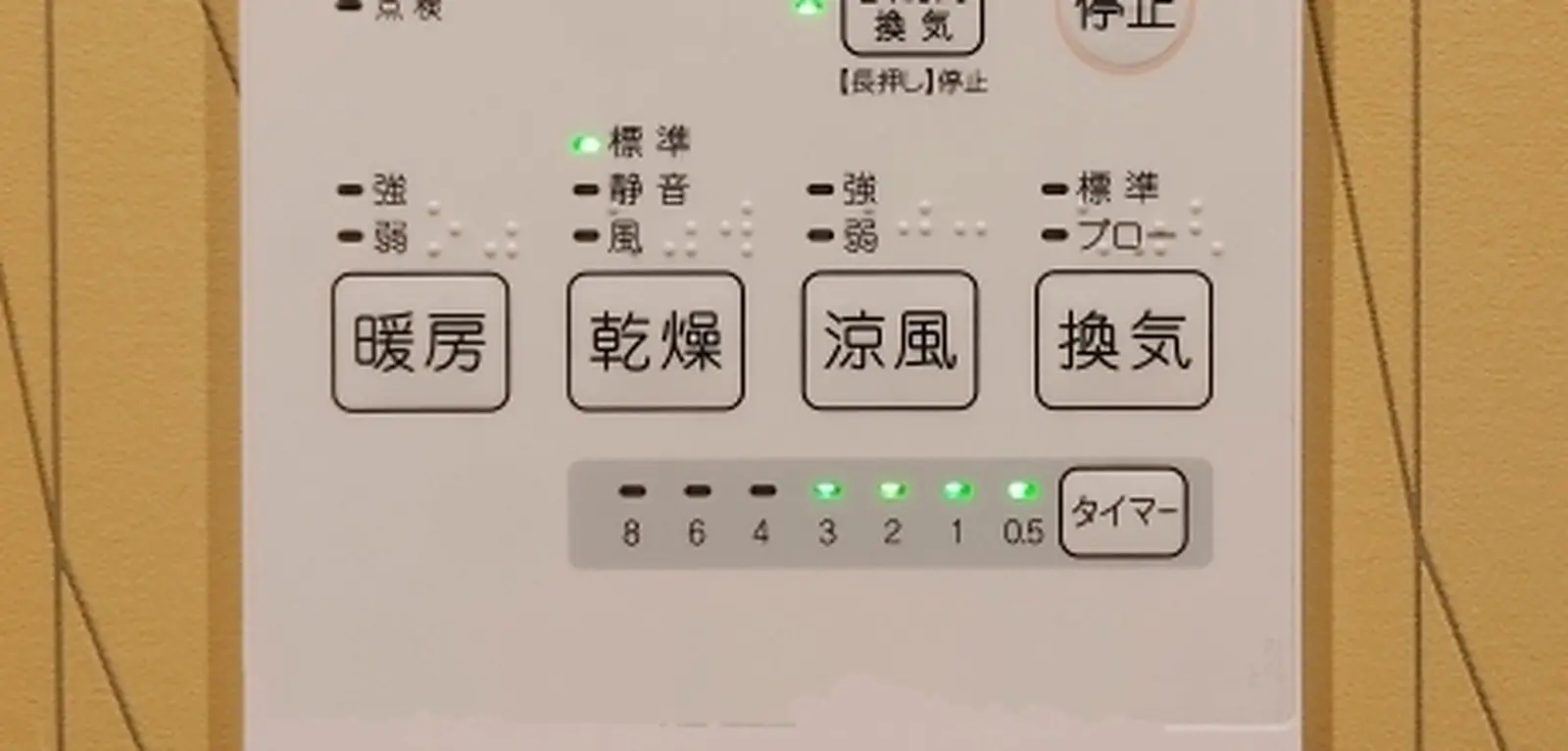
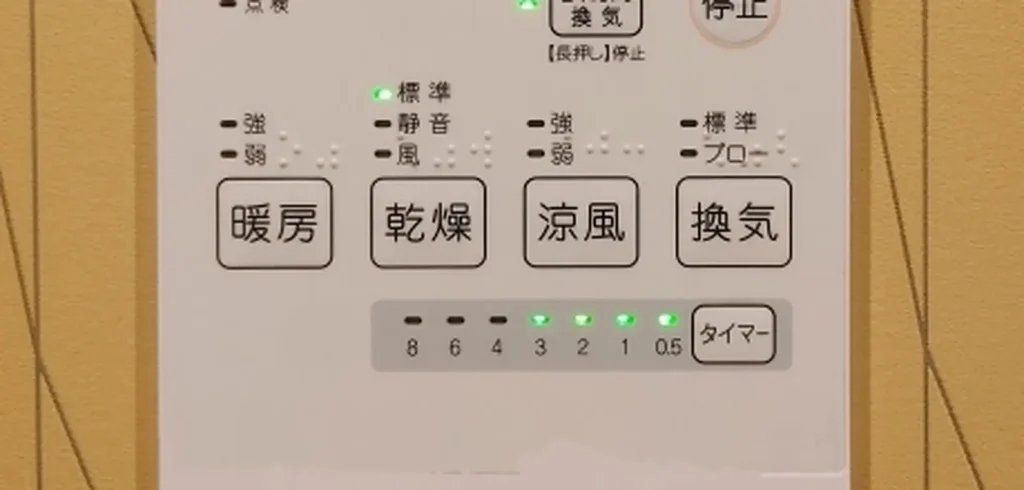
You search around, and eventually notice a suspicious-looking control panel full of buttons near the bathroom entrance.
This must be the thing I’ve heard about.
But you have no idea how to use it.
Relying on Google Translate, you press the button that says “Dry,” hang up your clothes, and go to sleep.
The next morning, what’s still hanging there is a damp T-shirt.
A very common Airbnb experience in Japan.
The truth is, Japanese bathroom dryers can dry your clothes overnight—if you use them correctly.
But make one small mistake, and no matter how long you run it, your laundry will stay wet.
In this article, we’ll use the most common type of bathroom dryer found in Japanese Airbnbs as an example, and explain:
- which buttons you actually need to press
- and why your clothes didn’t dry last time
Although the button labels and manufacturers may vary, the basic system works almost the same.
We’ll keep the explanation dry — so your clothes won’t be.
If you want a broader look at why laundry often fails to dry in Japanese Airbnbs—and what actually works using bathroom dryers, coin laundry machines, or simple in-room drying—you may also want to read
“Why Your Laundry Never Dries in Japanese Airbnbs—and What Actually Works.”
1. Common Mistakes (Miss These, and Your Laundry Won’t Dry)
This section covers the most common mistakes people make when using bathroom dryers in Japanese Airbnbs.
The control panels and brands may differ, but the basic logic is the same.
1-1. Pressing “Dry” While the Bathroom Is Still Wet
Mistake: Starting the dry cycle right after a shower, with wet walls and floors
Result: Your laundry doesn’t dry properly
Bathroom dryers work best in a space where the humidity is already low.
If there are water droplets all over the bathroom, the dryer ends up fighting the bathroom’s moisture first, not your clothes.
1-2. Not Using Ventilation — or Using Only Ventilation
Mistakes:
- Skipping ventilation and going straight to “Dry”
- Assuming ventilation alone is enough
Result: In both cases, clothes stay damp
Ventilation is not a drying mode.
It’s meant to remove moisture before drying, not replace the dry cycle.
1-3. Hanging Too Much Laundry at Once
Mistake: Hangers packed too closely, clothes touching or overlapping
Result: Uneven drying, stubborn damp spots
Bathroom dryers only work when warm air can actually reach the fabric.
If there’s no airflow between items, no amount of extra time will fix it.
1-4. Treating Thick and Thin Items the Same
Mistake: Hanging hoodies, jeans, and thick towels together
Result: Thin items dry, thick ones don’t
Thicker clothes hold much more water, especially around hoods and seams.
If you need to dry them, reduce the load and don’t expect miracles overnight.
1-5. Leaving the Bathroom Door Wide Open
Mistake: Keeping the door fully open to “let the moisture escape”
Result: Lower drying efficiency, and a humid room outside the bathroom
First, the basic rule: close the door.
But there’s a small trick that improves your chances.
Bathroom dryers still need a path for air to escape.
Most Japanese bathroom doors have a small built-in vent, so keeping the door fully closed is usually fine.
If the bathroom is completely airtight, however,
leave the door open just a few centimeters to create a narrow airflow path.
I call this the angel’s passage —
though the name hasn’t exactly caught on.
In the next section, we’ll put this all together into a simple, reliable routine:
Vent → Hang → Dry, explained step by step so you can follow it exactly as written.
2. The Correct Routine (Follow This Order and Your Clothes Will Dry)
From here on, we’ll walk through the actual steps using a MAX-brand bathroom dryer, the most commonly found type in Japanese Airbnbs.
Button labels and layouts may vary slightly, but the overall process is essentially the same, so you can apply this routine as-is.
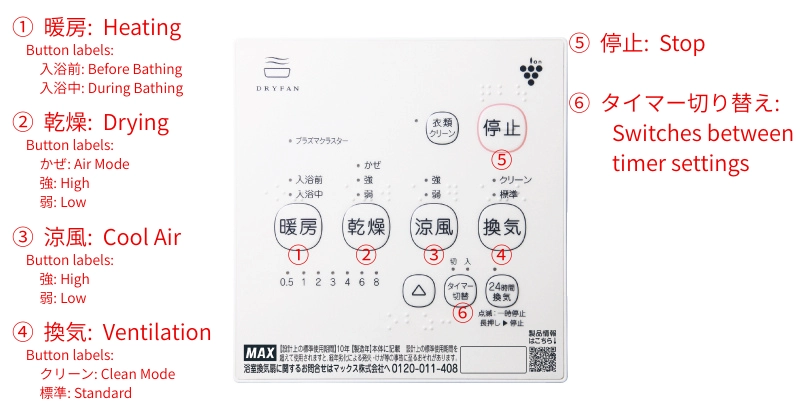
The circled numbers in the text correspond to the numbers shown in the reference image.
2-1. Start with “Ventilation” to Remove Moisture (About 10 Minutes)
First, check the condition of the bathroom.
If it’s humid after a shower or recent use, this step can dramatically increase your chances of success.
- Press the “Ventilation” button
<④ Ventilation: In this example, you’ll see options like Clean and Standard. Standard is perfectly fine.> - If a timer is available, set it to about 10 minutes
<⑥ Timer: This panel includes a 0.5-hour option—select that. It’s fine if you stop it early.>
Note:
If there are lots of water droplets on the walls or ceiling, take a moment to wipe them down with an old towel.
It’s a small hassle—but at that point, victory is basically yours.
2-2. Hang Your Laundry (Don’t Overcrowd)
Once ventilation is done, hang your laundry.
- Leave space between items
- Make sure clothes don’t overlap
- Hang thicker items toward the center, thinner ones toward the outside
Bathroom dryers only work when warm air can actually reach the fabric.
If you overcrowd things at this stage, there’s almost no way to fix it later.
2-3. Press “Dry” (This Is Where Drying Actually Starts)
After hanging your laundry,
now press the “Dry” button.
<② Dry: On this panel, you’ll see options like Breeze, Strong, and Weak. Strong is the safest choice.>
If you can set a timer, choose a reasonably long duration.
<⑥ Timer: Setting it to 6 hours or more usually gets the job done.>
The classic approach works well here:
set it before bed, check it in the morning.
2-4. Close the Bathroom Door (With One Exception)
As a rule, keep the bathroom door closed.
As explained in Chapter 1, if the bathroom is completely airtight,
leave the door open just a few centimeters to allow minimal airflow.
Key Takeaways from This Section:
- Don’t start with drying—lower the humidity first
- Leave enough space when hanging clothes
- Run the dry cycle for a sufficiently long time
- Close the door (but avoid complete airtight sealing)
3. Final Takeaway
Bathroom dryers in Japanese Airbnbs will dry your clothes properly overnight—
as long as you use them in the right order.
Follow the steps above, and you won’t wake up to a damp T-shirt hanging there in disappointment.
Enjoy your sightseeing in clothes that actually feel good to wear.
Authentic Japanese Souvenirs, Delivered
- Hotel delivery (no international shipping fees)
- Order before or during your trip and receive everything at your hotel
- Plan ahead and start sightseeing hands-free from day one
- Save time
- No more arriving in Japan only to find the souvenirs you wanted are sold out
- Skip the souvenir hunt and spend more time enjoying your trip
- All items are made in Japan
- Forget the worry of “Is this really made in Japan?”
- Every item is carefully selected and genuinely Japanese-made