If you’re planning to enjoy matching outfits as a couple on a trip to Japan, it’s only natural to want to add a touch of “Japan-ness” to what you wear. In that sense, the idea of a kanji-themed T-shirt isn’t a bad one at all.
That said, to be honest, most of the typical “giant kanji slapped on the chest” T-shirts feel a bit too much. From the outside—just as you probably worry—they can come across as a little cringey.
That’s why I’d suggest a more subtle kind of matching outfit—something that only people who know will notice. Instead of printing a big kanji front and center, you use it as a motif. Not something you wear because you’re “in a travel mood,” but something you can honestly say you wear because you like the design.
The problem is, options like that are surprisingly rare. You could even say they’re almost impossible to find, even in Japan.
In this article, I’ll explain the most practical solution: choosing a design before your trip and having it printed in your own country. I’ll walk you through the idea behind it and how to do it in practice.
- 1. Why Matching Outfits Actually Make Sense for a Trip
- 2. If You’re Going to Japan, It’s Natural to Want a “Japanese-Themed” T-Shirt
- 3. The Problem: Most Kanji T-Shirts Are, Honestly, Too Much
- 4. A Better Idea: Subtle Matching Using Kanji as a Motif
- 5. The Practical Part: Buy the Design Before the Trip and Print It in Your Own Country
- 6. Concrete Examples of Subtle Kanji-Inspired Matching Outfits
- 7. Conclusion
1. Why Matching Outfits Actually Make Sense for a Trip
1-1. Better Photos, Less Stress, and More Fun
When you travel, you naturally end up taking a lot of photos. If the two of you have some level of consistency in what you’re wearing, those photos tend to be more enjoyable to look back on later. The idea here isn’t so much “wearing identical outfits,” but rather having a shared concept or theme in your clothes.
There are practical benefits too. You spend less time in the hotel room every morning wondering, “What should I wear today?” And more than that, wearing those outfits itself becomes part of the trip. Turning one small decision into a little event, while also reducing the number of choices you have to make, is a surprisingly big plus.
1-2. A Decision That Makes Sense Because It’s a Trip
To be honest, many people feel a bit uncomfortable wearing matching outfits in everyday life. That slight sense of embarrassment is completely understandable. I’m actually one of those people myself.
But a trip is, by definition, not everyday life. Things you normally wouldn’t do can feel perfectly acceptable in the context of travel—and when you look back later, you often end up thinking, “That was the right call.” It shows up in photos, it makes preparation easier, and it’s fun.
In fact, the search volume for terms like “couple travel outfit” and “matching couple outfit” is quite high. In other words, this isn’t some niche hobby for a small group of people. It’s a fairly common option that many people seriously consider as something that makes sense specifically in the context of travel.
2. If You’re Going to Japan, It’s Natural to Want a “Japanese-Themed” T-Shirt
If your destination is Japan, it’s only natural to think, “Since we’re going all the way there, let’s add something a bit Japanese to our outfits.” The same applies to matching outfits for couples. Many people want some small, shared symbol that the two of you can enjoy together.
T-shirts with big anime characters on them, or designs with Mount Fuji splashed across the chest, certainly fit that idea—but they’re so symbolic that many people find them a bit too on-the-nose, and not exactly cool. It’s understandable to want a more understated way of bringing in a “Japan” element, rather than something that’s that obvious.
That’s where kanji come in as a very convenient motif. Even if you don’t understand the language, just seeing them immediately says “Japan,” and as a symbol, they’re incredibly strong. At the same time, depending on how you use them, they can be incorporated into a design in a very minimal way.
In other words, kanji are a motif that can instantly convey “Japan-ness,” while still leaving plenty of room to avoid overdoing it. They strike a balance that’s actually quite easy to work with.
3. The Problem: Most Kanji T-Shirts Are, Honestly, Too Much
3-1. From a Japanese Perspective, They’re Pretty Close to “Costume Wear”
If you look at the kanji T-shirts many tourists wear in the city, a lot of them follow the same pattern: a huge kanji character slapped right in the center of the chest. The font is often questionable, the meaning is often questionable—and the overall result is, more often than not, a bit awkward.
Of course, it’s easy to understand what the designers are trying to do. They want to emphasize “Japan-ness.” But from a Japanese point of view, many of these shirts end up feeling less like fashion and more like a kind of costume.
Imagine this for a moment: suppose your hometown is New York. How would you feel if you saw a tourist walking around in a T-shirt with nothing but a giant “NY” or the words “Statue of Liberty” printed across the chest, with no twist, no idea, no design beyond that? You’d probably feel a slightly awkward, second-hand embarrassment. The person wearing it might think it’s perfectly fine because they’re on a trip—but from the outside, it still feels a little off.
3-2. They Try Too Hard to Look “Japanese,” and End Up Dying as Fashion
Many kanji T-shirts made for tourists tend to cram in every “Japanese-looking” symbol they can: kanji, overly stylized pseudo-Japanese fonts, and on-the-nose motifs. The result is something that certainly signals “Japan,” but puts any real sense of fashion on the back burner.
In photos, these shirts can look kind of fun. But when you actually walk around the city in them, they often end up sticking out in an awkward way. In other words, they’re designs that only really make sense if you assume “this is fine because I’m in travel mode.”
So the core problem is simple: by pushing “Japanese-ness” too hard, most kanji T-shirts stop functioning as clothes you’d want to wear—and start functioning more like tourist costumes.
4. A Better Idea: Subtle Matching Using Kanji as a Motif
4-1. “Using kanji” doesn’t mean “printing big kanji”
What’s worth rethinking here is what it really means to “use kanji.” It doesn’t have to mean simply printing a large character on a T-shirt.
For example, instead of treating kanji as “language meant to convey a meaning directly,” you can use it as a design motif. If you do that, the shirt can look like a regular design T-shirt at first glance—but when you look more closely, you notice kanji woven into the design, adding a small twist and a subtle sense of Japan-ness.
4-2. The idea of “If you know, you know” matching outfits
When you apply this idea as a couple, one important point is not to make both designs exactly the same. If the designs are identical, an unnecessary sense of “we’re overexcited tourists” tends to creep in.
By keeping the concept the same but using two different designs, you can keep that extra “tourist hype” in check while still presenting a pair that feels unified, even though the looks are different. That shift—from “tourists in a high mood” to “a couple with style”—is the key.
This also works when you look back at your travel photos later. It becomes a “If you know, you know” kind of detail. You don’t have to loudly advertise either “Japan” or the fact that you’re matching—yet the shared context between the two of you is still clearly there. And that, in the end, fits this purpose much better.
5. The Practical Part: Buy the Design Before the Trip and Print It in Your Own Country
To put it simply, for this kind of T-shirt, preparing it before your trip is far more practical in almost every way than trying to look for one after you arrive in Japan.
First, you avoid any sizing issues. Sizing standards vary slightly from country to country, and T-shirts you find in tourist areas often come in a limited range of sizes. If you have it printed in your own country beforehand, you can get it in the size you normally wear, without any guesswork.
More importantly, as I’ve been explaining so far, there simply aren’t many options that meet these conditions in the first place. Most kanji T-shirts you find in tourist areas are designed in a very “tourist mode” kind of way. The chances of randomly finding something you truly like—something that isn’t overly “Japanese” and actually works for a couple—during your trip are, frankly, very low.
If you choose the design in advance, you won’t have to rush into a souvenir shop, feel pressed for time, and end up putting something into your basket that you’re not really satisfied with.
The best approach is to pick a design you genuinely like during your trip preparation period and have it printed through a T-shirt printing service in your own country, in a fit that works for you. That, in the end, is the most sensible solution.
6. Concrete Examples of Subtle Kanji-Inspired Matching Outfits
Based on the ideas we’ve discussed so far, I’ve prepared a few concrete examples that show what this approach can look like in practice.
All of these are designed with the same principles in mind: they use kanji, but not in an overly “Japan-themed” way; at first glance they look like ordinary design T-shirts; and as a pair, they share a unified concept.
The files are provided in formats that can be uploaded directly to print services like Printful or Printify. If you find something you like, you can get the design before your trip and have it printed through a service in your own country.
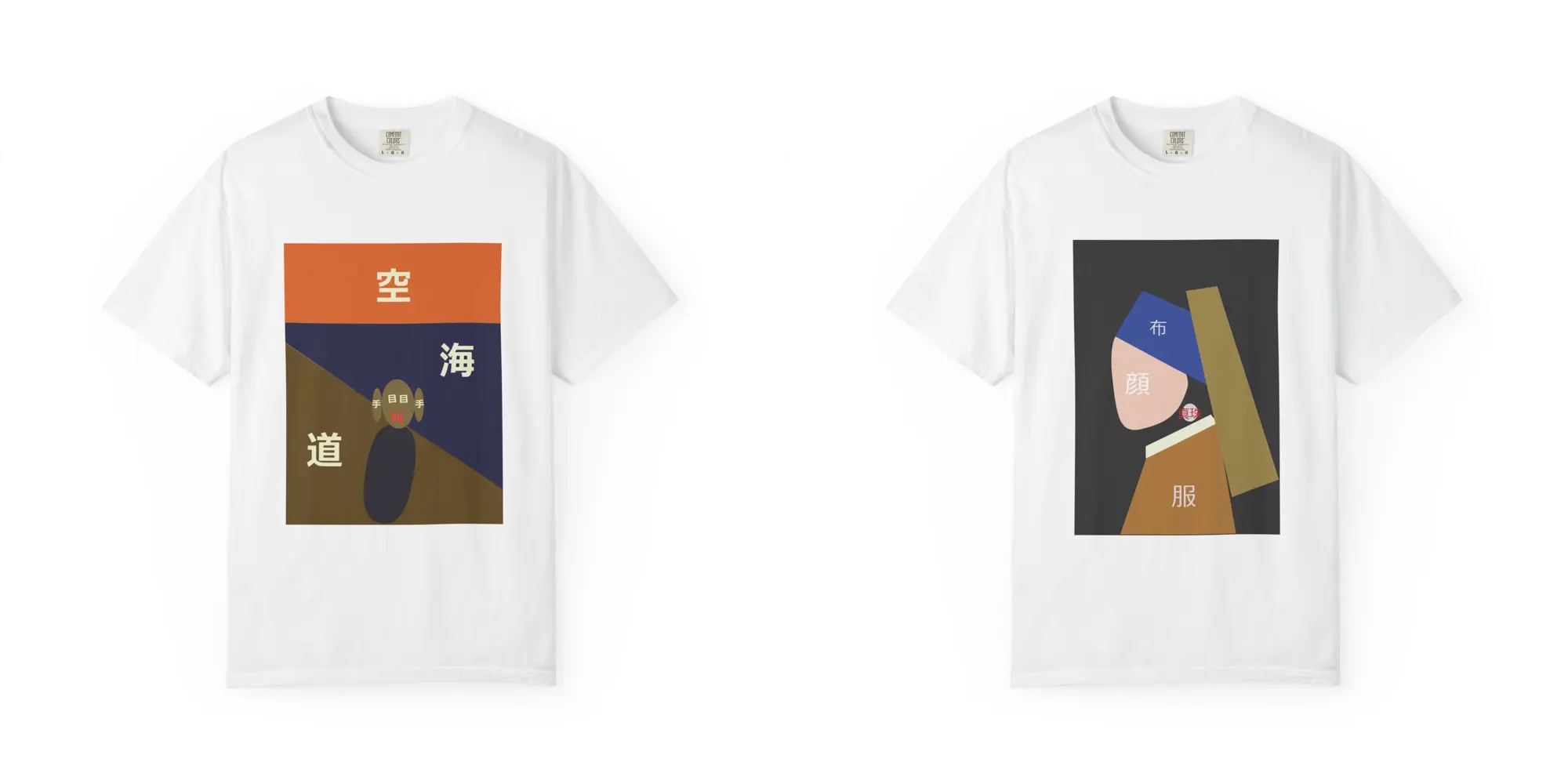
6-1. Famous Paintings × Deconstructed Kanji Parts
The first set is based on well-known paintings, reworked into graphic designs.
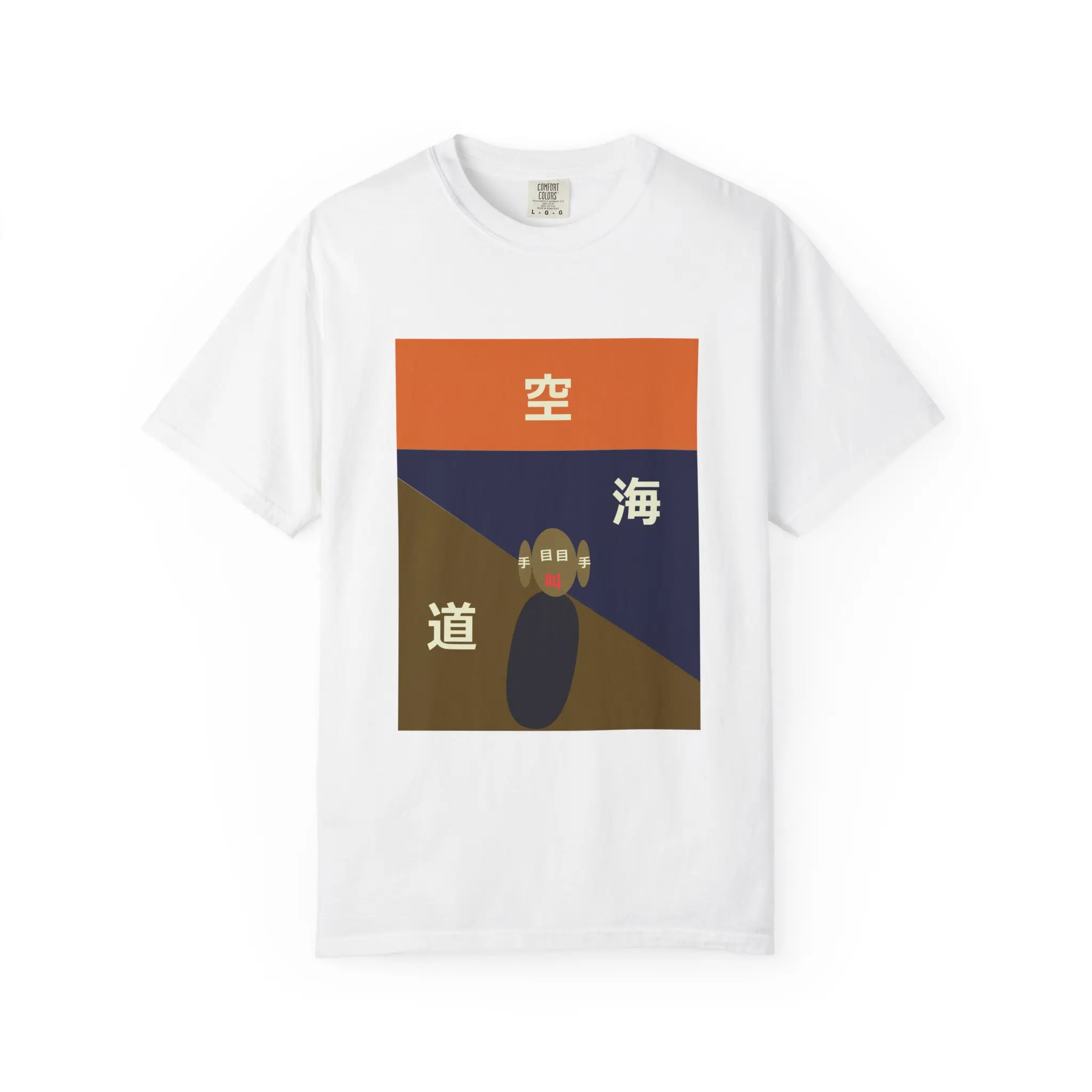
- For him: Edvard Munch, The Scream
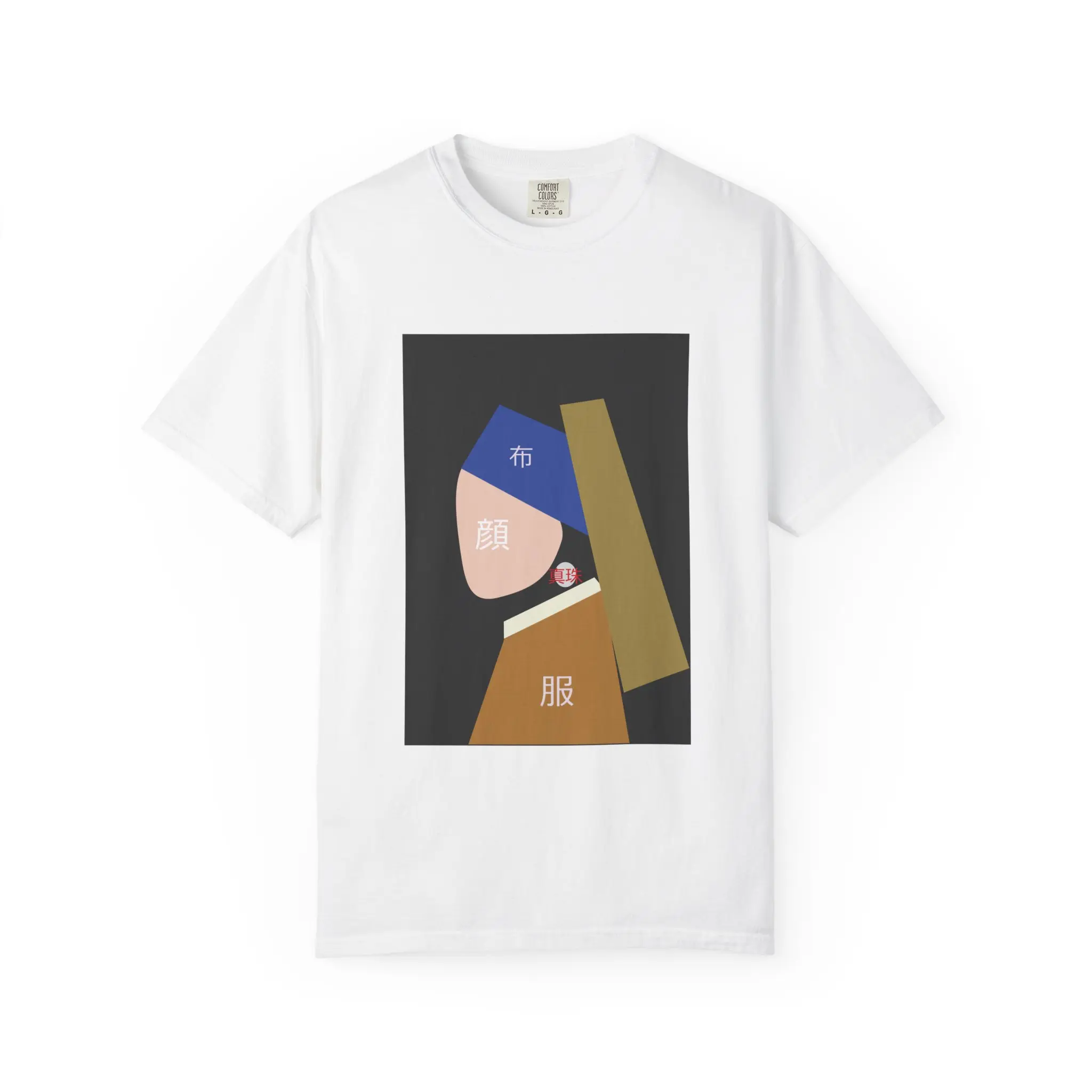
- For her: Johannes Vermeer, Girl with a Pearl Earring
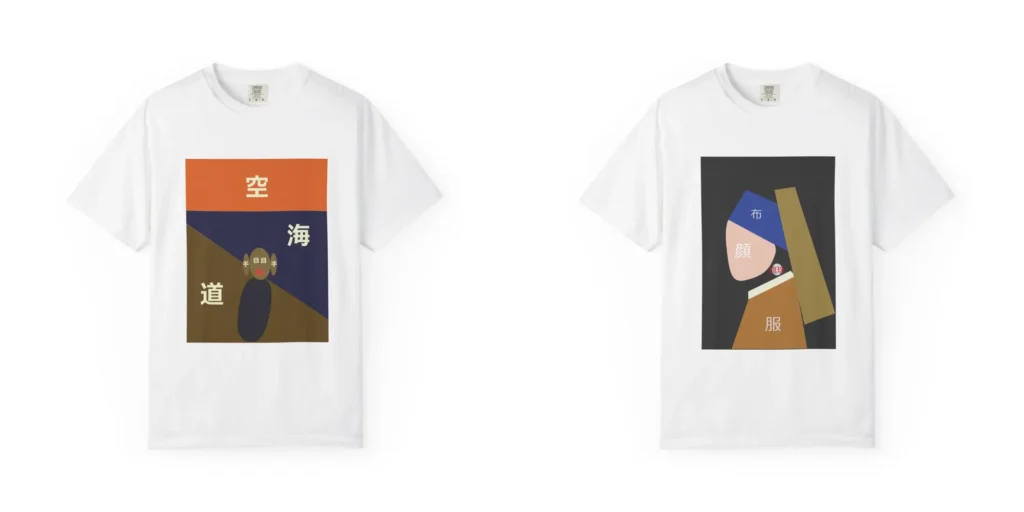
Each motif is broken down into geometric parts, and kanji characters are placed within those parts. At first glance, these look like art-poster-style T-shirts, but when you look more closely, you notice that kanji are woven into the design.
This approach keeps the look firmly design-focused, without drifting too far into “too Japanese.” At the same time, the use of kanji gives the shirts a distinctive character you don’t usually see.
When worn as a pair, you can also see the relationship: different motifs, but the same underlying idea. That contrast is part of what makes this set interesting.
6-2. Minimal, with a Touch of Playfulness in the Kanji Composition
The second set is for people who prefer something more minimal, but still want a small element of playfulness.
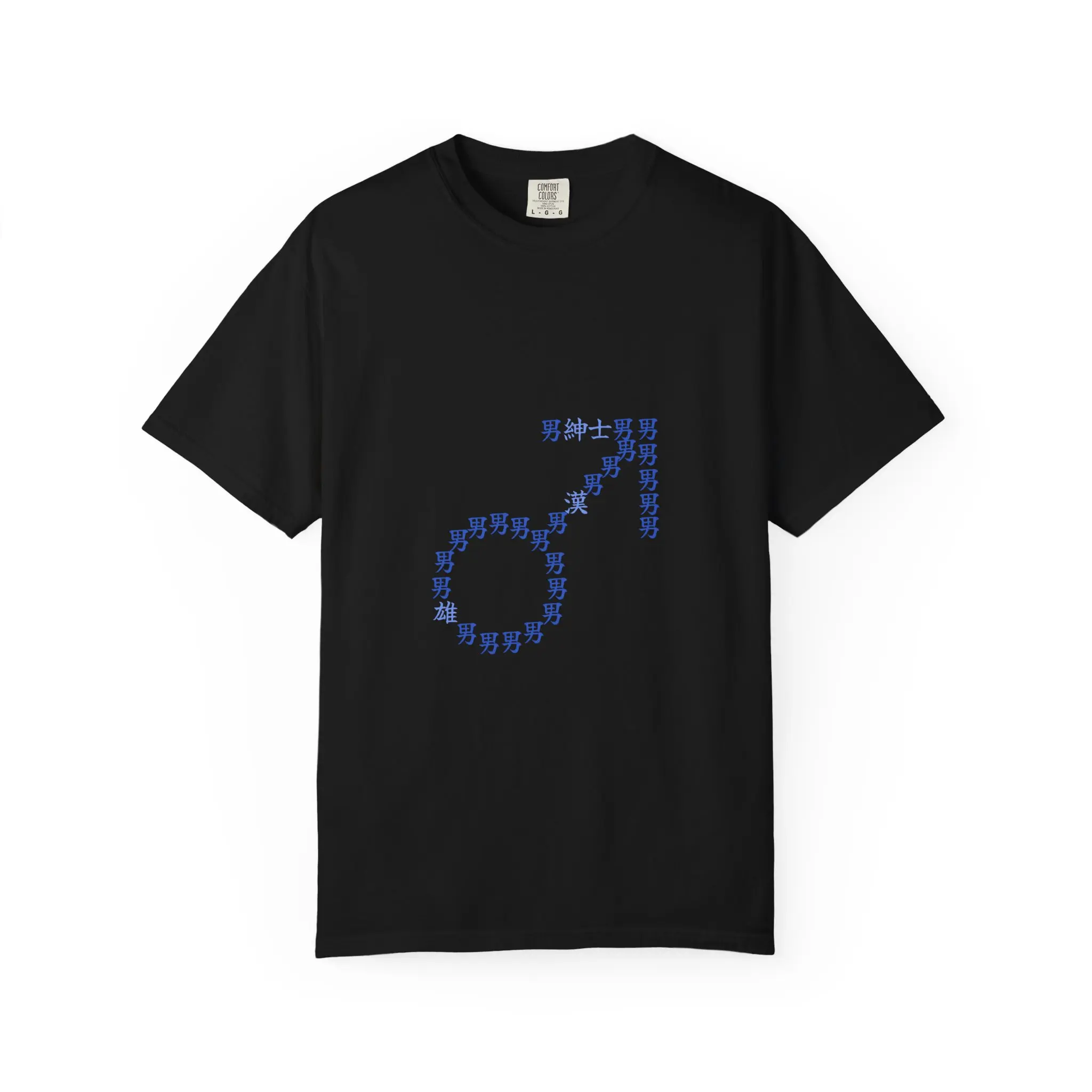
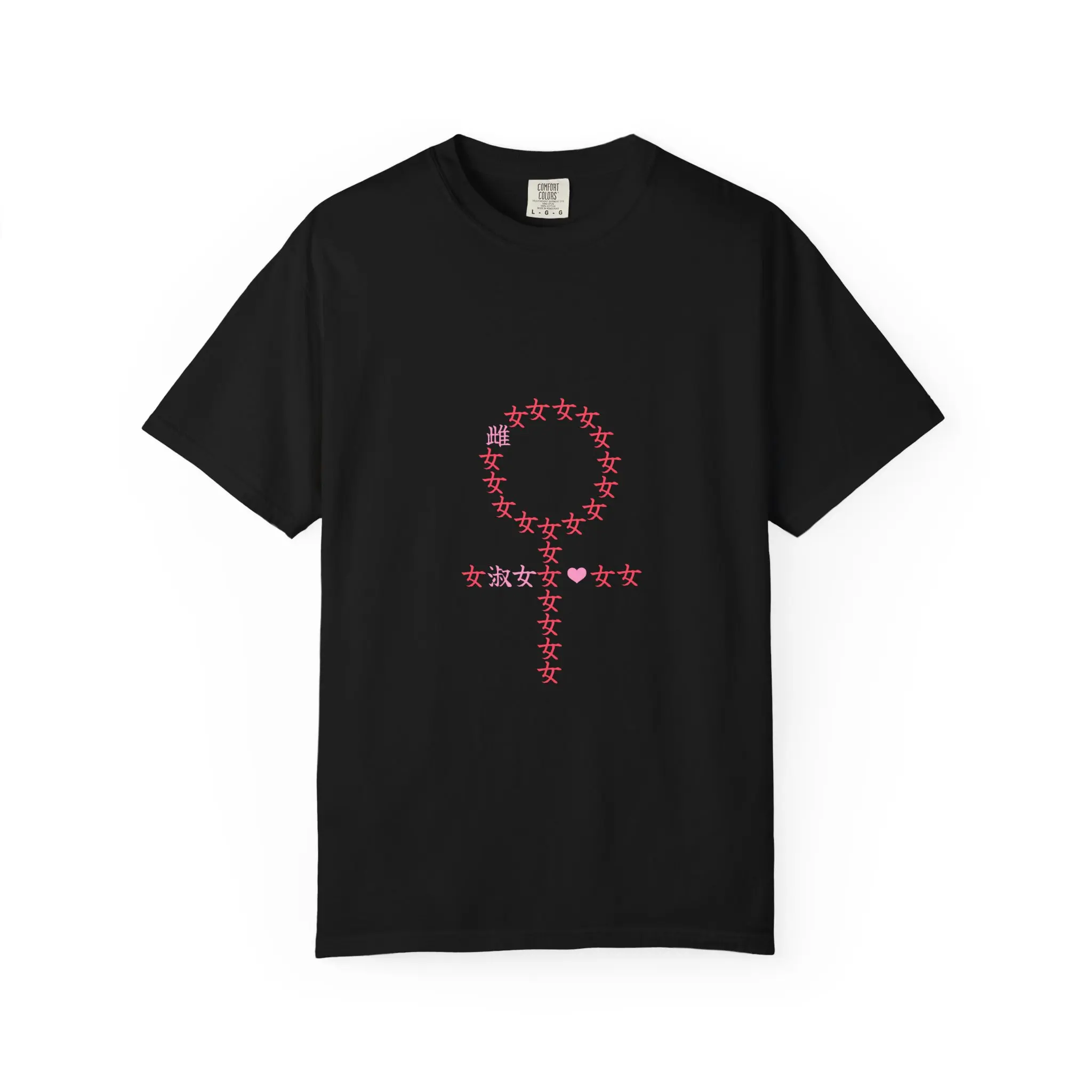
The designs are built by arranging kanji characters to form the symbols for male and female. The core structure uses the characters 「男」 (man) and 「女」 (woman), with characters like 「雄」, 「雌」, 「紳士」 (gentleman), and 「淑女」 (lady) added in places to create subtle variations.
From a distance, these look like simple typography T-shirts. Up close, you realize how the characters are being used and arranged.
This is a very minimal take on the “If you know, you know” idea of matching outfits.
6-3. Using Ukiyo-e Motifs Without Looking Like Tourist Souvenirs
The third set is for those who still want to use clearly Japanese motifs.
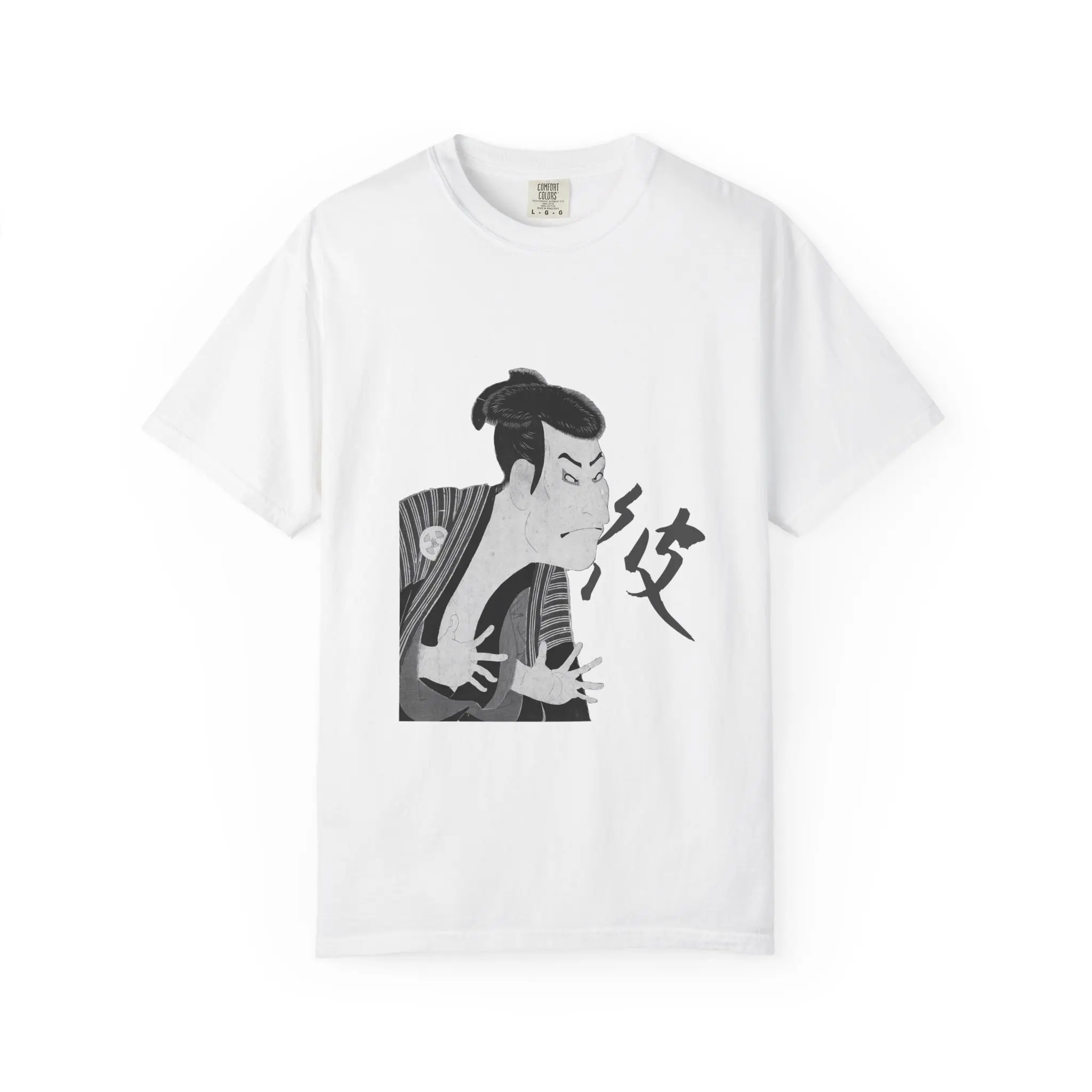
- For him: Tōshūsai Sharaku, Ōtani Oniji III as Edobei
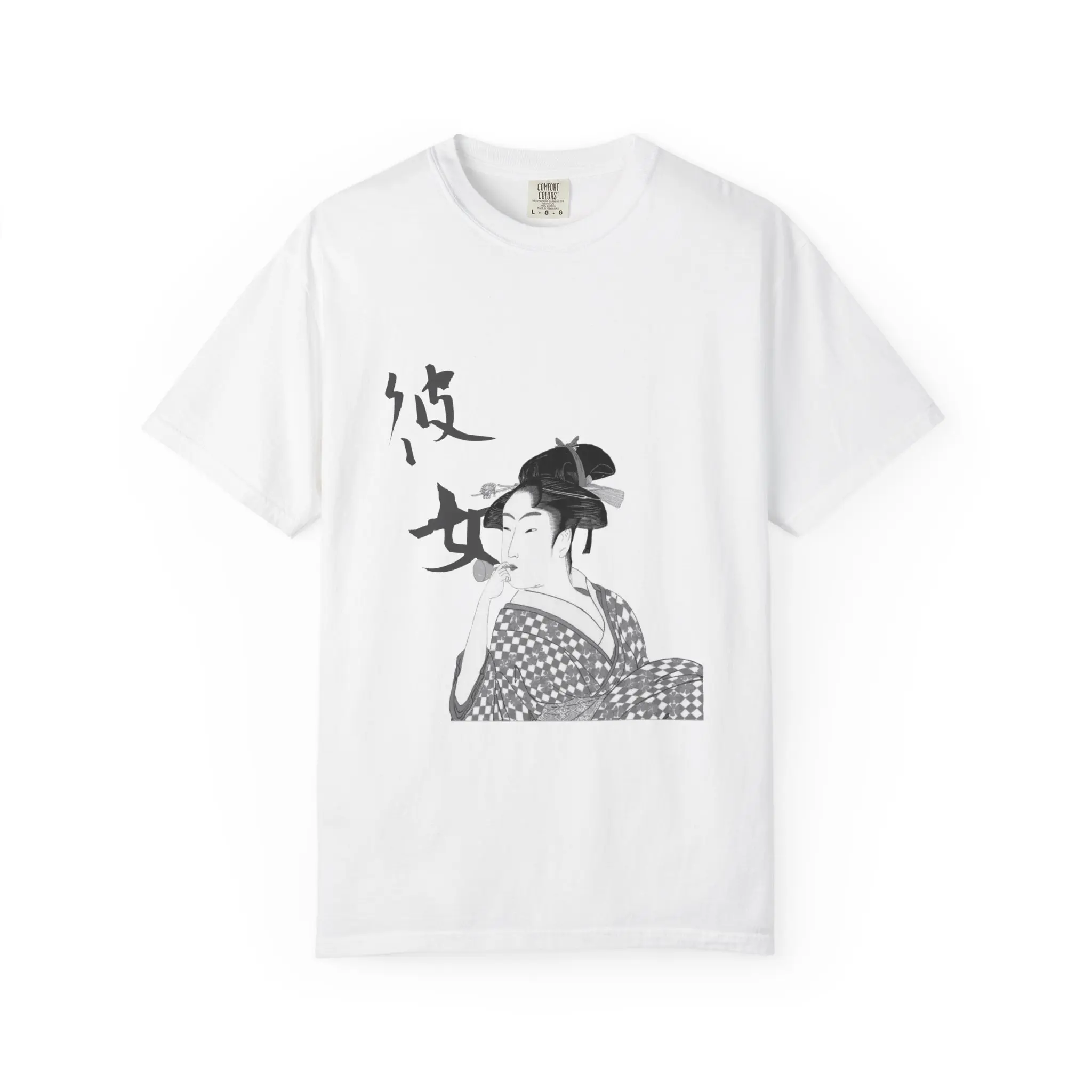
- For her: Kitagawa Utamaro, Woman Blowing a Glass Toy
Both are extremely famous ukiyo-e prints, but they’re deliberately placed in monochrome to avoid the typical “tourist souvenir T-shirt” look. On top of that, the characters 「彼」 (he) and 「彼女」 (she) are added to subtly indicate the relationship between the two shirts.
The images themselves are very Japanese, but by keeping the colors and composition restrained, the overall balance makes them easier to wear in everyday city settings.
They clearly have a Japanese flavor, but stop short of feeling like they’re shouting “Japan.”
Note:
- This product includes digital design files only (the T-shirts themselves are not included).
- The files are formatted for use with print services such as Printful and Printify.
- Each set is priced at $2.99.
- In the sample images, the designs are shown on white or black T-shirts, but you’re free to choose any base color or garment style you like.
- Depending on the season, you can also print these designs on pullovers or hoodies instead of T-shirts.
7. Conclusion
When you’re thinking about matching outfits for a trip to Japan, the important thing isn’t “looking as Japanese as possible.” Big kanji printed front and center certainly make it obvious that you’re in Japan, but the truth is, they often don’t work very well as real clothes.
You want something you can actually enjoy as fashion—and as a matching outfit. That’s why it makes more sense to choose a design before your trip and have it printed in your own country, instead of searching around once you arrive.
Simple, easy to wear, and meaningful to the two of you. A matching outfit with that kind of distance and restraint is probably the most comfortable choice in the end.