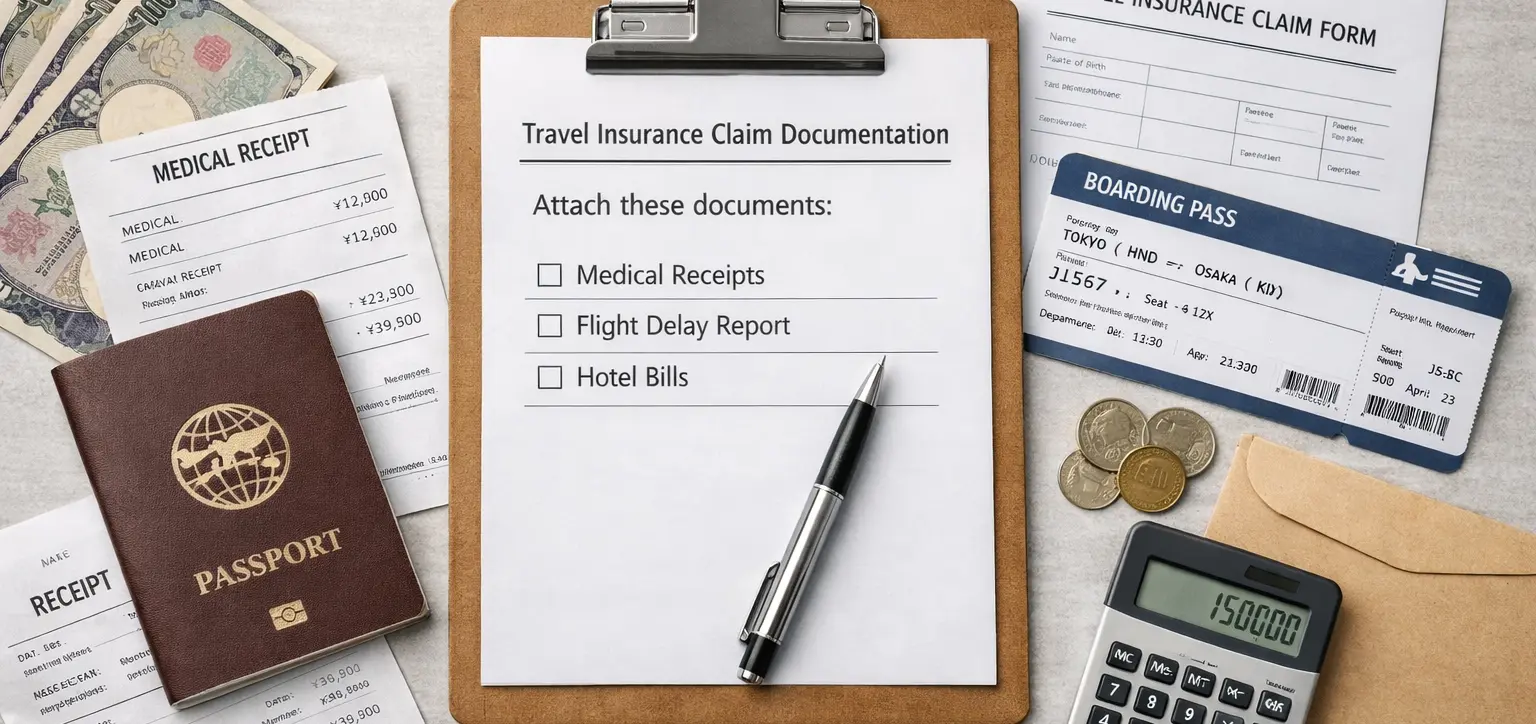
- 0. Conclusion: Insurance Claims Are Not About Hospitals — They Are About Paperwork
- 1. How to Obtain the Six Required Documents in Japan
- 2. Why Claims Get Stuck Even When the Documents Seem Complete
- 2-1. The Documents Exist, but the Information Is Insufficient
- 2-2. Translation or English Documents Are Requested Later
- 2-3. Proof of Payment Is Weak or Not Clearly Linked
- 2-4. Travel Proof Is Weak or the Timeline Does Not Connect
- 2-5. The Submission Deadline Is Misunderstood
- 2-6. Form Requirements Do Not Match
- 3. A Minimal Claim Workflow
- 4. Practical Templates
- 5. Final Takeaway
0. Conclusion: Insurance Claims Are Not About Hospitals — They Are About Paperwork
Whether a travel insurance claim related to a trip to Japan gets approved
is not decided by which hospital you visited or what kind of treatment you received.
In many cases, the deciding factor is much simpler:
whether the required documents and evidence are complete and properly prepared.
In practice, many claims are denied—or sit unresolved for weeks or even months—not because of the medical treatment itself, but because of administrative issues like these:
- The itemized bill is missing
- The medical report or doctor’s note does not meet the insurer’s requirements
- English documents or translations are requested later
- Proof of payment or travel evidence is weak or incomplete
- The submission deadline has passed,
or the claimant misunderstood the starting point of that deadline and delayed filing
In other words, insurance claims are not a medical problem.
They are a paperwork and evidence problem.
If These Are Missing, Your Claim Will Stop
Most insurance claims stall because the following six core documents are not fully prepared.
This is the first checklist insurers look at before anything else.
The Minimum Claim Packet
- Medical report / Doctor’s note
(Written confirmation of diagnosis or treatment) - Itemized bill
(A detailed breakdown of medical services) - Official receipt
(Proof that the expense was actually paid) - Proof of payment
(Credit card statement or equivalent) - Travel proof
(Itinerary, boarding passes, passport entry stamps, etc.) - Claim form (if required)
(The insurer’s designated claim form)
If any one is missing, the claim often can’t be processed and may remain pending until it’s provided.
While this checklist focuses on medical claims,
non-medical claims often require additional incident-specific documents, such as a police report for theft, a carrier statement for flight delays or cancellations, or an accident report when a third party is involved.
The Winning Strategy Is Simple
Avoiding claim problems comes down to three basic rules:
- Collect documents before you leave
Anything that can only be obtained at the hospital should be secured on the spot - Do not lose anything
Keep receipts, bills, and certificates together as one complete set - Submit early after returning home
File as soon as possible, assuming that something may be missing
If you follow these principles, filing a claim related to Japan becomes a manageable administrative process rather than a guessing game.
What This Checklist Covers
In this article, you will find:
- Which documents are absolutely required to keep a claim moving
- How to obtain them at Japanese hospitals
- The most common reasons claims get stuck
- A minimal, time-based claim workflow
- Short English phrases you can use on the spot
You do not need to read your insurance policy from beginning to end.
What you need is a practical standard that lets you quickly see
what is missing from your claim right now.
An Important Note
This article does not guarantee that your claim will be approved.
Final decisions are always made according to each insurer’s policy terms and review process.
However, reducing the risk of delays or denials caused purely by missing documents or procedural mistakes
is something every traveler can do.
That is exactly what this checklist is designed for.
1. How to Obtain the Six Required Documents in Japan
In this chapter, we will go through the Minimum Claim Packet (six core documents) introduced in Section 0,
and explain how to realistically obtain each of them at medical facilities in Japan, step by step.
One thing is critical to understand from the start:
In Japan, once you leave the hospital, some documents become extremely difficult—sometimes practically impossible—to obtain again.
That is why knowing what to ask for and when to ask for it matters.
1-1. Medical Report / Doctor’s Note
What insurers typically require
In most cases, insurers are looking for an official medical record that clearly shows:
- The date of the visit
- The diagnosis
- The treatment provided
- The physician’s name and signature (or hospital identification)
In other words, a formal statement issued by a doctor, not just a receipt.
What to know in Japan
- In Japan, medical certificates are usually
not free and not issued immediately - English medical certificates are often:
- Not available at all, or
- Issued only after several days (or longer), or
- Available for an additional fee
Practical approach
First, confirm with your insurer (or the online claim portal) what type of medical document is required.
Then ask the hospital:
- Whether the document can be issued
- Whether English is available
- The fee
- The expected processing time
In Japan, medical certificates are often not issued on the same day.
What matters is not receiving the document immediately,
but completing the request process before you leave the hospital.
Before leaving, make sure that:
- The request has been formally submitted at the reception desk
- Any required fee has been paid
- The method of receiving the document is clearly confirmed
(later pickup or postal delivery)
For short-term travelers, returning to the hospital later may be impractical.
If possible, confirm whether postal delivery is available and how long it will take.
1-2. Itemized Bill
What is required
Insurers usually need more than a total amount.
They want a breakdown showing items such as:
- Consultation
- Tests
- Procedures
This is what is meant by an itemized bill.
What to know in Japan
- In Japan, the receipt and the itemized statement are often separate documents
- The itemized bill is not always handed out automatically
Practical approach
- At the payment counter, explicitly ask for:
“a detailed statement” or “an itemized bill” - A Japanese-language document is usually sufficient,
as long as the contents are clear
Note on prescription medication
For outpatient visits, it is common for costs to be split between:
- The hospital or clinic (consultation, tests), and
- A separate pharmacy (medication)
If you receive prescription medicine,
keep the pharmacy receipt (and itemized statement, if available)
together with the hospital documents.
Important: In Japan, medical costs are often split between the hospital and a separate pharmacy.
Make sure you collect and keep documents from both locations, or medication costs may be excluded from your claim.
1-3. Official Receipt
What is required
A formal receipt showing:
- The payment date
- The amount paid
- The medical facility’s name
What to know in Japan
- Reissuing receipts is often difficult
- Some insurers require the original receipt
Practical approach
- Keep the receipt flat and secure
- Store it together with the itemized bill
- Take photos or scans as backup
1-4. Proof of Payment
What is required
Evidence that the expense was actually paid, such as:
- A credit card statement
- A bank transaction record
What to know in Japan
- If you pay in cash, the receipt may be the only proof of payment
- Even with card payments, insurers may request the statement later
Practical approach
- Use a credit card when possible
- Expect that statements may take time to appear
1-5. Travel Proof
What is required
Documents showing that the medical expense occurred during your trip.
Common examples
- Flight tickets or boarding passes
- Travel itineraries
- Passport entry stamps, landing permission stickers (if any), or other official entry records
Practical approach
- Digital copies are usually fine
- Make sure you can clearly show when you were in Japan
1-6. Claim Form (If Required)
What may be required
Depending on the insurer and the type of claim, you may be asked to submit:
- A designated claim form
- A form that includes a section for a physician’s statement or signature
What to know in Japan
- In many cases, these forms are shown only after you start the claim online
- Japanese hospitals may not agree to fill out insurer-specific forms
Practical approach
- Start the claim online as early as possible to confirm what is required.
- If the hospital will not complete the insurer’s form, ask whether a medical certificate containing the required details (diagnosis, visit date, treatment) can be submitted instead.
- Some insurers accept equivalent documents, while others require their own forms. Confirm this early.
2. Why Claims Get Stuck Even When the Documents Seem Complete
By this point, you may be thinking:
“I collected all six documents. I submitted everything.”
And yet, the claim still does not move.
This is common.
In this section, we will look at the most frequent reasons claims stall even when the paperwork appears complete, specifically in the context of travel to Japan.
2-1. The Documents Exist, but the Information Is Insufficient
This is the single most common issue.
- A medical certificate exists, but the diagnosis or treatment is vague
- An itemized bill exists, but it is not clear what each charge represents
- A receipt exists, but the payer or medical facility is not clearly identifiable
Insurers do not simply check whether a document exists.
They check whether the information needed to make a decision can be clearly understood.
In these cases, the claim is usually not denied outright.
Instead, it enters a pending state while additional information is requested.
2-2. Translation or English Documents Are Requested Later
Even if you submit all documents in Japanese, you may later receive requests such as:
- “Please provide an English translation.”
- “An English medical certificate is required.”
This is not unusual.
It is common for claims originating in non-English-speaking countries.
The key point is this:
Just because translation was not requested initially does not mean it will not be requested later.
Practical response
- Submit the claim as early as possible, assuming follow-up requests may occur
- Some insurers accept non-certified translations (including self-prepared ones), but requirements vary.
2-3. Proof of Payment Is Weak or Not Clearly Linked
This issue often arises with credit card payments.
- The medical charge amount does not exactly match the credit card statement
- The statement lists a payment processor rather than the hospital name
From the insurer’s perspective,
it is unclear whether the payment corresponds to the claimed medical expense.
Practical response
- Submit the receipt, itemized bill, and card statement as a set
- If necessary, include a short explanation stating
that the payment shown corresponds to the submitted medical documents
2-4. Travel Proof Is Weak or the Timeline Does Not Connect
For a claim to be valid, insurers must confirm that the expense occurred during the trip.
Claims tend to stall when:
- Entry or exit dates are unclear
- The relationship between the travel dates and the treatment date is ambiguous
- The country of stay cannot be clearly established
Practical response
- Combine multiple forms of travel evidence
(itinerary, boarding passes, passport stamps) - Make the timeline obvious at a glance:
when you were in Japan, and when treatment occurred
2-5. The Submission Deadline Is Misunderstood
Deadline-related problems are more often caused by misinterpretation, not forgetfulness.
Common misunderstandings include:
- Assuming the deadline is based on the treatment date,
when it is actually based on the return date or payment date - Missing deadlines for submitting additional requested documents
- Delaying submission with the assumption that “there is still time”
As a result,
the claimant believes the submission was timely,
while the insurer treats it as late.
2-6. Form Requirements Do Not Match
This is where otherwise complete claims often stall.
Examples include:
- A required physician signature field is left blank
- The insurer rejects the documents because a designated form was not used
This happens most often with medical-related claims.
Practical response (clarified)
- Confirm with the insurer whether the designated claim form is mandatory,
or whether equivalent documents (such as a medical certificate) are acceptable - If alternatives are allowed,
confirm exactly which details must be included
(diagnosis, visit date, treatment details, physician signature, etc.) - Do not proceed on assumptions.
Written confirmation from the insurer can prevent delays later
Most stalled claims are not caused by missing documents.
They stop because:
- Information is incomplete
- Documents do not clearly connect
- Requirements are interpreted differently by each side
These small mismatches accumulate and bring the process to a halt.
3. A Minimal Claim Workflow
— Organized by Timeline —
Filing an insurance claim is not complicated by itself.
What causes problems is moving forward without a clear sense of what to do, and when to do it.
In this section, we lay out a minimal, practical claim workflow, organized by timeline, designed to avoid the common failure points discussed earlier.
Step 1. Before Leaving the Hospital (Day 0)
Some documents can only be obtained at this stage.
What you must secure
- A document request that clearly covers the diagnosis and treatment
(medical certificate or medical report) - The itemized bill
- The official receipt
What to confirm
- Whether a medical certificate can be issued
- The fee and expected processing time
- That the itemized bill and receipt are separate documents
If you miss this step, retrieving these documents later can become extremely difficult.
Step 2. Before Returning Home / Immediately After (Day 1–3)
At this stage, the task shifts from collecting documents to organizing them.
What to do
- Gather the six required documents in one place
- Identify what is missing
- Organize travel proof (itinerary, boarding passes, passport stamps)
Key point
- “I’ll do it later” is the most common cause of delays
- Even if the set is incomplete, build the full picture early
Step 3. Start the Claim (As Early As Possible)
For most insurers, starting the claim online is the moment when:
- The final list of required documents
- Whether a designated claim form exists
- Submission deadlines
become clear.
What to do
- Start the claim online
- Check for designated forms or additional requirements
In many cases, whether a designated claim form is required
only becomes clear after you start the claim online.
For that reason, at this stage, confirm whether the insurer requires the specific form, or whether equivalent documents such as a medical certificate are acceptable.
Ideally, this would be clarified while you are still at the hospital.
However, confirming it at this point is still workable in practice and not too late.
Step 4. Submit the Claim (As Early As Possible)
You do not need to wait until every document is perfect before submitting.
Basic approach
- Submit what you already have
- Assume missing items can be added later
What to do
- Upload or send the available documents
- Add brief explanations where needed
- Record the submission date and keep copies of everything
Note: Even if you submit documents online, keep the original receipts and certificates.
Some insurers may request original copies later.
Step 5. Respond to Follow-Up Requests
Many claims do not end with a single submission.
Common follow-ups
- Requests for translations
- Additional proof of payment
- Requests to resubmit or clarify documents
How to handle them
- Follow-ups are not denials
- Respond as quickly as possible, using the same claim thread
- Keep a record of what you have already submitted
The key to a smooth claim process is not submitting perfect paperwork all at once.
It is about keeping the process moving.
Act early.
Respond through the same channel.
Maintain a consistent narrative.
Doing just that significantly reduces the chances of your claim getting stuck unnecessarily.
4. Practical Templates
— Simple Japanese Phrases That Get Your Point Across —
What matters here is not speaking Japanese fluently.
Even if the phrasing is awkward, the goal is simply to prepare Japanese sentences that
clearly communicate your intent in places where English may not be available.
Accuracy matters more than elegance.
Each template below is structured in three parts:
- Japanese — what you can show or point to
- Pronunciation — so you can read it out loud if needed
- English — the meaning you are conveying
4-1. Asking About a Medical Certificate at a Hospital
When to use this
- You need a document for an insurance claim
- You want to check availability, cost, and timing
Japanese
保険請求に使う診断書が必要です。
Pronunciation
Hoken seikyuu ni tsukau shindansho ga hitsuyou desu.
English
I need a medical certificate for an insurance claim.
Japanese
英語でなく、日本語の診断書でも大丈夫です。
Pronunciation
Eigo de naku, Nihongo no shindansho demo daijoubu desu.
English
It does not have to be in English. A Japanese document is fine.
Japanese
発行は可能ですか?
Pronunciation
Hakkou wa kanou desu ka?
English
Is it possible to issue it?
Japanese
料金はいくらですか?
Pronunciation
Ryoukin wa ikura desu ka?
English
How much does it cost?
Japanese
発行までどれくらい時間がかかりますか?
Pronunciation
Hakkou made dorekurai jikan ga kakarimasu ka?
English
How long will it take to issue?
4-2. Requesting an Itemized Bill at the Hospital
When to use this
- You need a breakdown, not just a total amount
Japanese
保険請求に使うので、診療明細書をください。
Pronunciation
Hoken seikyuu ni tsukau node, shinryou meisaisho o kudasai.
English
I need an itemized bill for an insurance claim.
Japanese
合計金額だけでなく、内訳が分かるものが必要です。
Pronunciation
Goukei kingaku dake de naku, uchiwake ga wakaru mono ga hitsuyou desu.
English
I need a document that shows the breakdown, not just the total.
Japanese
領収書とは別に、明細書もお願いします。
Pronunciation
Ryoushuusho to wa betsu ni, meisaisho mo onegai shimasu.
English
Please provide the itemized bill separately from the receipt.
4-3. Getting a Receipt at the Pharmacy
When to use this
- You paid for prescription medicine
- You need proof of payment
Japanese
保険請求に使うため、領収書をください。
Pronunciation
Hoken seikyuu ni tsukau tame, ryoushuusho o kudasai.
English
I need a receipt for an insurance claim.
Japanese
可能であれば、薬の明細もください。
Pronunciation
Kanou de areba, kusuri no meisai mo kudasai.
English
If possible, I would also like an itemized list of the medication.
5. Final Takeaway
Insurance claims are not decided at the hospital, but later, through how you handle the paperwork.
Remember just three things: the claim starts the moment treatment ends, documents matter more than explanations, and speed and consistency matter more than perfection.
Collect what you need on the spot, submit early, and respond within the same flow. If you do that, claims stop being a matter of luck and become a manageable process.
If you want to step back and review which insurance questions are actually worth worrying about for your trip to Japan, the decision guide below maps out the bigger picture.
→ Travel Insurance for Japan: A Decision Guide