Have you ever done laundry during a stay at a Japanese Airbnb?
And the next morning, after hanging your clothes overnight, thought:
“…Wait. These aren’t dry, are they?”
Or perhaps you’ve already found yourself surrounded by a pile of damp, half-dry clothes,
after exhausting every option, and ended up on this page.
This is not a rare problem.
In winter and during Japan’s rainy season, laundry simply doesn’t dry.
That is a plain fact.
Japanese housing—especially the apartments and condominiums commonly used as Airbnbs—has almost every condition needed to make natural air-drying fail.
Yes, laundry problems are technically something “time will solve.”
But the amount of time required is well beyond what most travelers can afford.
In this article, we’ll break down two things:
why laundry struggles to dry in Japanese Airbnbs,
and what actually works for travelers dealing with it.
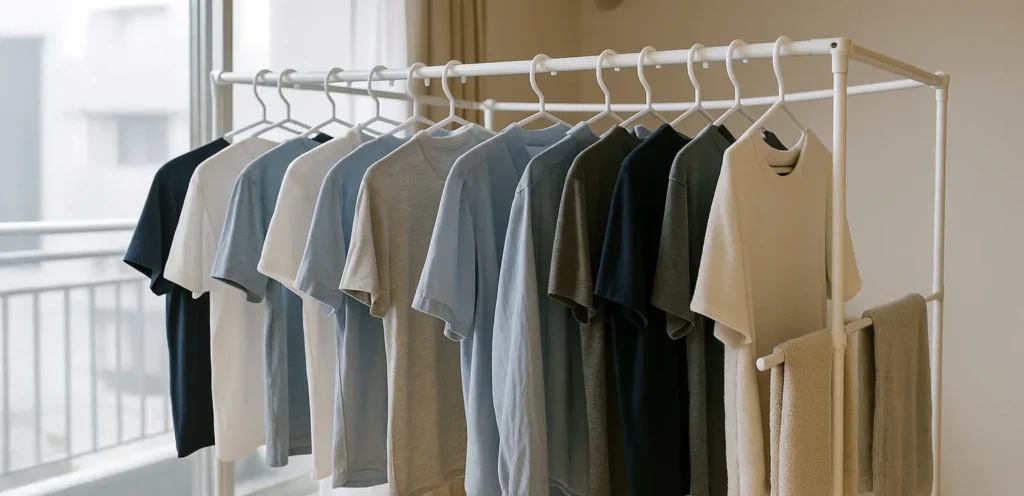
1. Why Laundry Struggles to Dry in Japanese Airbnbs
When this happens, it’s hard not to glare at your half-dry clothes with quiet resentment.
But there are a few unavoidable reasons behind it.
1-1. Climate Factors
During the Rainy Season and Summer
Japan’s high humidity is well known, and during the rainy season and summer, it becomes especially severe.
Average humidity in summer often exceeds 70%,
and during the rainy season, it can climb past 90%.
In conditions like these, it’s hardly surprising that laundry holds onto moisture.
Frankly, no one can really blame the clothes.
During Winter
In winter, the air itself is relatively dry
(though humidity levels still hover around 50%).
Even so, laundry often fails to dry, due to a different set of overlapping factors:
- Low temperatures slow down evaporation
- Windows stay closed, causing indoor humidity to rise quickly
- Apartment layouts allow very little air movement
Taken together, these conditions are far from ideal for drying clothes.
1-2. Appliance Factors
Most Japanese Airbnbs are equipped with top-loading washing machines without drying functions.
They can spin-dry your clothes,
but the “drying” step simply doesn’t exist.
As a result, laundry ends up being hung indoors,
where the climate factors above do the rest—
and nothing dries.
In short, while the reasons differ by season,
natural air-drying is unreliable in Japanese Airbnbs year-round.
This isn’t your fault.
And it certainly isn’t your laundry’s fault.
2. Practical Ways to Dry Your Laundry in Japanese Airbnbs
Reducing how often you do laundry or switching to quick-drying fabrics can certainly help.
However, those approaches place real constraints on your travel style, so we won’t focus on them here.
Instead, here are just three methods that let you feel a real difference
without changing how you travel.
2-1. Use a Coin Laundry Dryer
This option costs money, but it works—reliably.
In urban areas, coin laundries are easy to find using Google Maps.
With roughly ¥1,000, you can fully dry an entire load of laundry, with no lingering odor.
That said, Japanese coin laundry dryers operate at very high temperatures.
If you put in clothes that aren’t designed for machine drying, you may experience disasters such as:
- An adult sweater being reborn as a child-sized one
- A silk undergarment developing holes after only three wears
Always check the care labels before using the dryer.
(Full drying success rate: 95%)
2-2. Use the Bathroom Dryer
If your Airbnb has a bathroom dryer, this is another solid option.
Many Japanese Airbnbs are equipped with one.
Drying usually takes about 3 to 6 hours,
but the risk of ending up with damp clothes drops significantly.
Key points to keep in mind:
- Use “Dry(乾燥 or 衣類乾燥)” mode, not “Ventilation(換気)”
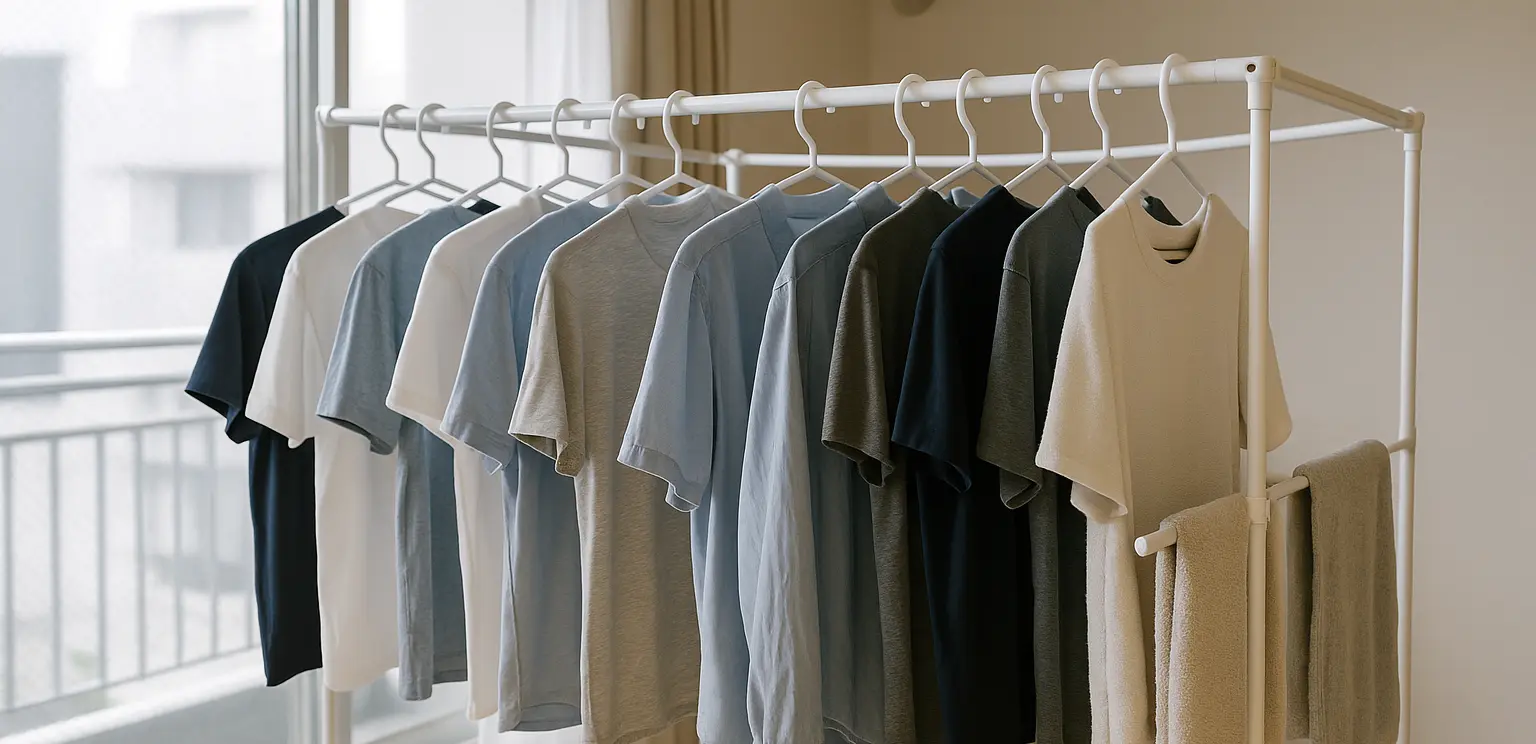
- Leave enough space between hangers (clothes won’t dry if they’re touching)
- Face thicker parts of garments outward
(Full drying success rate: 80%)
For a step-by-step guide on how to use Japanese bathroom dryers properly—and avoid common mistakes—see
“How to Use the Bathroom Dryer in Japanese Airbnbs (So Your Clothes Actually Dry).”
2-3. Air Conditioner Dehumidifying (Dry Mode) + Fan
If there’s no nearby coin laundry
and your Airbnb doesn’t have a bathroom dryer,
your only option is to improve the indoor drying environment.
In winter, set the air conditioner to heating(暖房) + airflow.
During the rainy season, use dehumidifying (ドライ) mode.
Combine this with a fan or circulator to blow air directly onto the clothes.
The same hanging tips mentioned in section 2-2 apply here as well.
One important warning:
If you accidentally use dehumidifying mode in winter,
Japanese air conditioners will lower the temperature along with the humidity.
Unless your goal is to make the room as cold as the outdoors, this is not recommended.
(Full drying success rate: 50%)
Choose the method that best fits your situation.
There are tricks involving irons or hair dryers,
but if you’d prefer not to risk burning down the entire apartment
just to dry a shirt, it’s best to avoid them.
3. Final Thoughts
Few things drag down a trip like damp clothes—or a bad restaurant.
Use the approaches above as needed,
and don’t waste your time or energy on problems that don’t deserve it.
Focus on what actually matters,
and enjoy the trip you came for.
Authentic Japanese Souvenirs, Delivered
- Hotel delivery (no international shipping fees)
- Order before or during your trip and receive everything at your hotel
- Plan ahead and start sightseeing hands-free from day one
- Save time
- No more arriving in Japan only to find the souvenirs you wanted are sold out
- Skip the souvenir hunt and spend more time enjoying your trip
- All items are made in Japan
- Forget the worry of “Is this really made in Japan?”
- Every item is carefully selected and genuinely Japanese-made