0. Conclusion First
When choosing travel insurance, you may have found yourself thinking something like this:
“I’ll be in an unfamiliar country. I’m more likely to catch a cold or get a minor injury.
Wouldn’t it be safer to pick a plan that covers small illnesses and accidents well — or even one with zero deductible?”
That instinct is completely natural.
However, when it comes to travel in Japan, the conclusion is different.
For trips to Japan, paying extra to get better coverage for minor illnesses and injuries usually doesn’t make much sense.
When choosing travel insurance for Japan, you should generally avoid plans that are designed to
“make small claims more profitable.”
Just keeping this one principle in mind will already eliminate most bad choices.
In the next sections, we will look at why this is the case —
how insurance claims are actually decided,
how Japan’s medical system works in practice,
and what you should prioritize instead.
In this article
- Why small medical claims often fail in Japan
- Why “zero deductible” plans don’t work the way you expect
- What actually matters when choosing travel insurance for Japan
1. What Travel Insurance Claims Actually Require
When you file a travel insurance claim, insurers are not judging
how much pain you were in,
how anxious you felt,
or how much you hoped your insurance would cover.
What they look at is whether there is enough evidence to justify paying you — in other words, paperwork.
In practice, almost every insurer bases its decision on the same two things.
1-1. Proof of what you paid for, and how much you paid
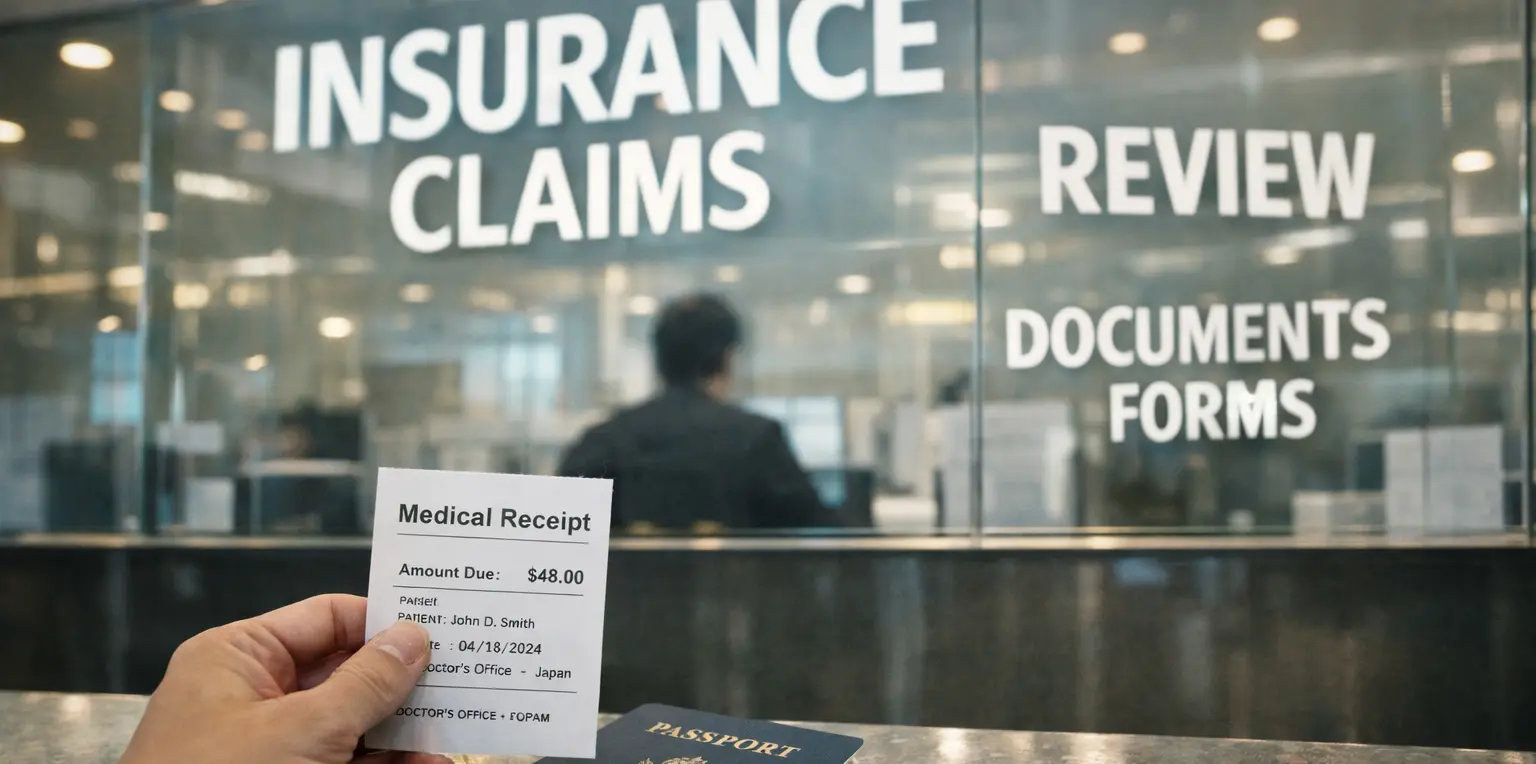
First, you need documents showing what treatment you received, how much it cost, and that you actually paid for it.
This usually means things like:
- an itemized bill from a hospital or clinic
- a receipt
- a credit-card statement or payment slip
Insurers use these to confirm:
- that medical expenses were really incurred
- and that the treatment falls within what the policy covers
1-2. Proof of what the doctor diagnosed
Just as important is documentation showing
how a doctor evaluated and diagnosed your condition.
This can take the form of:
- a medical certificate
- a doctor’s report
- or medical records that include a diagnosis
The key point here is this:
Insurers do not rely on your statement that
“my head really hurt.”
They rely on what diagnosis the doctor wrote down.
Only when both of these are present —
- how much you paid, and
- what you were diagnosed with
— does an insurance claim become something the insurer can actually evaluate.
In that sense, travel insurance does not really cover “medical problems.”
It covers medical treatment that can be proven on paper.
2. Why Japan’s Medical Paperwork Breaks Small Insurance Claims
As we saw in the previous section, travel insurance claims are based on two things:
- what you paid for
- and what the doctor diagnosed
In other words, insurers need documents that prove that legitimate medical treatment actually took place.
Only when both of these are present does your claim even reach the point where it can be evaluated.
However, Japan’s medical system is optimized for treating patients, not for producing insurance-friendly paperwork.
In practice, this means that one of these two elements — the doctor’s diagnosis — often does not appear automatically in the documents you receive.
2-1. The paperwork you get at checkout often does not include a diagnosis
When you visit a clinic or hospital in Japan, you are given a medical statement and a receipt at the cashier.
But in many cases, that medical statement does not include a disease name or diagnosis.
In fact, it is more accurate to assume that it usually won’t.
What you typically see instead are things like:
- consultation fees
- prescription fees
- test fees
In other words, you get a list of actions and prices — but not what condition those actions were for.
From a medical point of view, this is perfectly fine.
From an insurance point of view, it means you are left with paperwork that does not clearly show what you were treated for.
2-2. Getting a diagnosis “on paper” requires extra steps
In many cases, if you need a document that clearly states the diagnosis and the doctor’s assessment, you must request it separately.
That usually means:
- applying for a medical certificate or doctor’s report
- paying an additional fee (at large hospitals in Japan, fees around ¥8,000–¥11,000 per document are not unusual at large hospitals.)
- waiting several days — or even weeks — for it to be prepared
2-3. Why this makes small claims so hard
For minor illnesses or injuries, the medical bill itself is usually not very high.
But to get that few thousand — or ten-something thousand — yen back from your insurance, you now have to:
- request a medical certificate
- pay for it
- wait for it
- and submit it to the insurer
In other words, the expected payout from a small claim often does not justify the time, effort, and extra cost required to make that claim valid.
That is why, in Japan,
the smaller the medical issue, the less sense it often makes to file an insurance claim.
If you want a concrete checklist of what documents insurers actually require, see the practical guide below.
→ Japan Travel Insurance Claims: A Practical Paperwork Checklist
3. Why Small Medical Claims Become a Trap in Japan
Let’s look at how everything we have discussed so far plays out in a real situation in Japan.
You catch a cold while traveling in Tokyo and visit a nearby clinic.
The consultation and medicine cost ¥8,500.
Your travel insurance has zero deductible and clearly states that outpatient visits are covered.
At this point, most people think:
“Okay, I’ll get this back from my insurance later.”
At the cashier, you receive a medical statement and a receipt.
However, no diagnosis is written on them.
When you contact your insurance company, they tell you:
“Please submit a medical certificate or a document showing the doctor’s diagnosis.”
So you call the clinic and ask for a medical certificate.
In broken English, you are told:
- It can be issued
- The fee is ¥10,000
- It will take 1 to 2 weeks
You are trying to get back ¥8,500.
But to do so, you now have to pay ¥10,000 and wait up to two weeks.
At this point, most travelers give up.
The claim may be valid on paper, but in practice it simply is not worth it.
No matter how generous “zero deductible” or “outpatient coverage” sounds,
the cost of even entering the claims process is too high.
That is the reality of travel insurance in Japan.
4. What to Look for in Japan Travel Insurance Instead
As we have seen, travel insurance designed to reimburse small illnesses and minor injuries does not work very well in Japan.
So what should you actually spend your money on?
The answer is simple:
protection against situations where medical costs rise beyond what you could reasonably pay out of pocket.
In those situations, a doctor’s diagnosis, detailed medical records, and large bills tend to be generated as part of the normal hospital process.
In other words, even within Japan’s medical system, you are now in a zone where the evidence insurers need naturally exists.
That is when travel insurance finally works the way it is supposed to.
Some insurers are better suited for this kind of “high-impact, low-frequency” risk than others.
For example, plans like World Nomads tend to make more sense when your priority is protection against major medical or accident-related costs — rather than trying to recover small outpatient fees.
If you want to see how this principle translates into choosing the right insurance for a trip to Japan,
it is explained in detail in the next article.
→ Do You Really Need Travel Insurance for Japan? A Simple Rule for When It Matters
5. In Short
Japan’s medical system is excellent at treating patients — but it is not designed to generate insurance-friendly paperwork for small, routine visits.
As a result, minor illnesses and injuries are often the hardest ones to claim, even when your insurance technically covers them.
For travel in Japan, the smart approach is not to optimize for small reimbursements, but to make sure you are protected against situations that become truly expensive.
If you want to review how this conclusion fits into the broader set of travel insurance decisions for Japan, the decision guide below maps out the other questions worth checking.
→ Travel Insurance for Japan: A Decision Guide