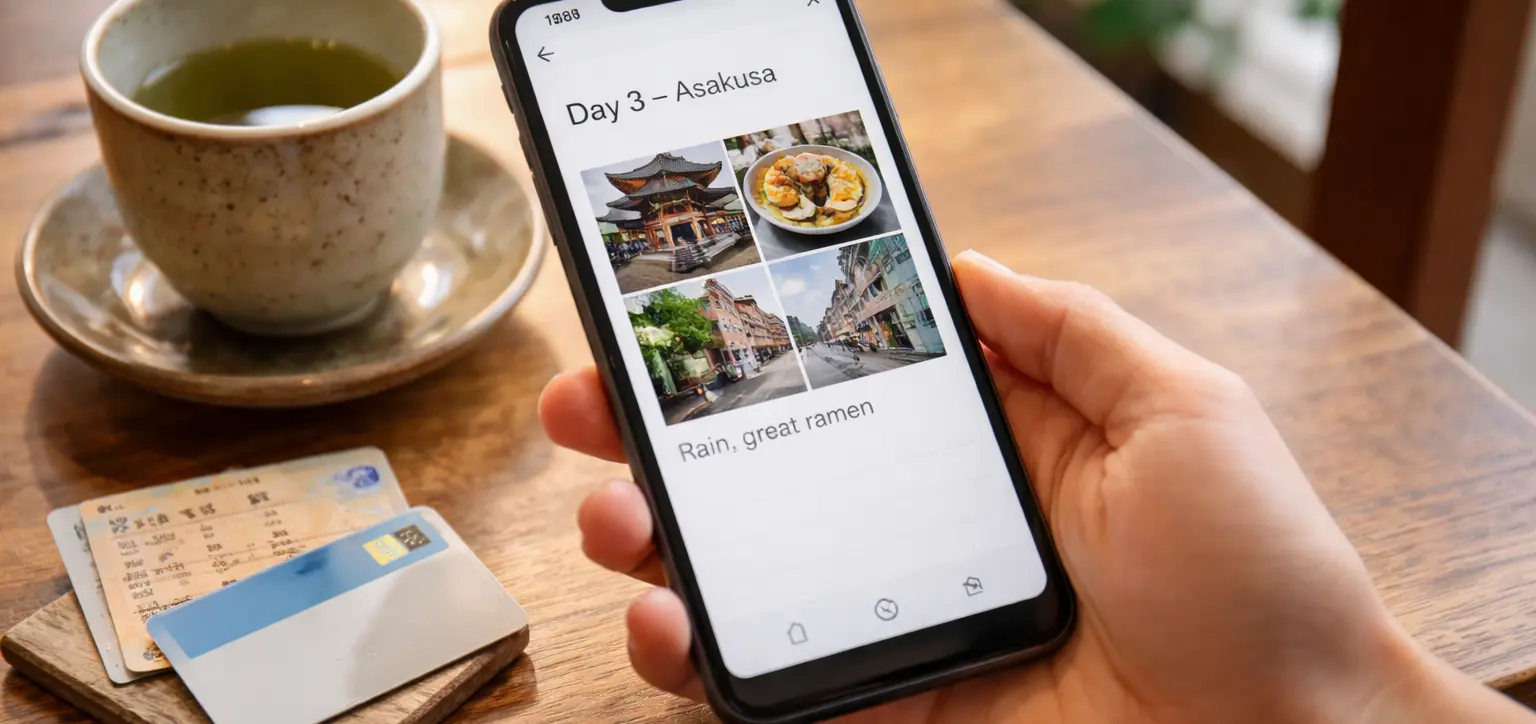
When you travel, the number of photos you take tends to grow naturally.
A cityscape seen from a train window, a small shop you found down a side street, the color of the evening sky, a companion’s smile. Wanting to keep these moments in the form of photos is something people share everywhere, and a trip to Japan is no different. Before you realize it, your smartphone’s camera roll is filled with images.
After you return home, you might find yourself looking back at those photos.
As you scroll through the screen, thinking, “Oh, we went there too,” it can feel like a small bonus of the trip. At the same time, there are moments when you have to pause and think about where a particular photo was taken.
What were you doing at that moment?
Why did you decide to take that picture?
How were you feeling?
The photos remain, but the finer details are left outside the frame.
Still, in your camera roll, scenes from the trip are lined up, one after another.
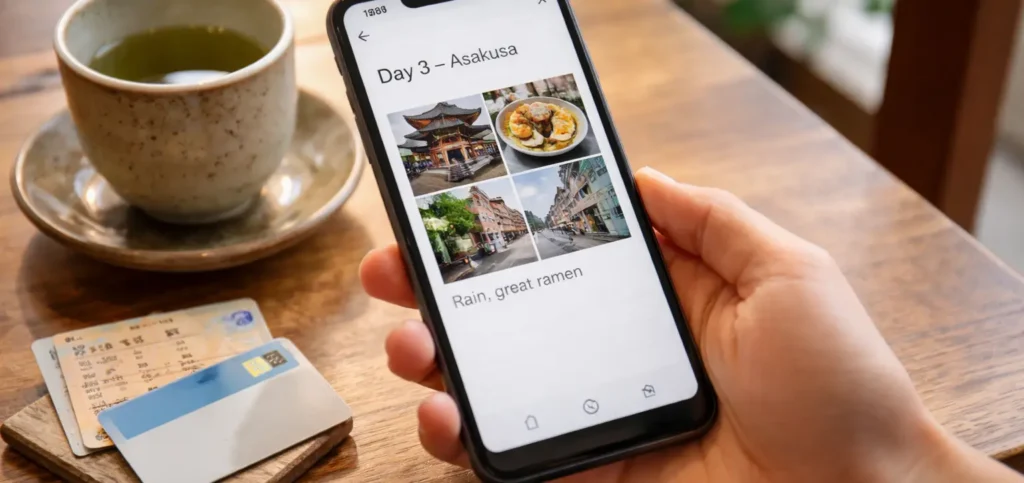
1. Why Japan Trip Photos Fade Faster Than You Expect
When you travel, a lot of things get packed into a short amount of time.
You move around a lot, see many different things, and go through a series of first-time experiences. Before you know it, the day is over.
Even if you come back with plenty of photos, what you felt at that famous spot, your honest reaction to the meal you were looking forward to, or a casual remark from your travel companion—those things do not fit inside an image. And when you look back later, those kinds of memories often turn out to be the ones that matter.
That is why some people try to leave something besides photos.
Some bring a small notebook and write down the day when they get back to the hotel, while others just keep notes on their smartphone, anyway, and plan to sort them out later.
“Being able to keep travel memories a little more easily would be nice.”
There is nothing strange about thinking that. I have often felt the same way myself while traveling.
2. What Actually Makes a Travel Record Easy to Look Back On
When people think about a record that is easy to look back on, they often imagine a well-written diary or a neatly organized notebook.
But a format you can keep without strain during a trip—and one that brings memories back naturally when you open it later—tends to be decided by much simpler conditions.
For example:
- The photo and a short note from that moment are placed together
- The amount you write is small (one or two lines is enough)
- You do not have to think about the date or the place yourself
- You can keep it up without it becoming a burden during the trip
Imagine taking a short break at a café after walking around, waiting for your drink to arrive.
In those few minutes, you just add one short line next to the photo you took earlier. That is about as much effort as it needs.
None of these points are about making a “perfect” or “beautiful” record.
They are about whether, when you look at the photos later, the moments and feelings from that time come back with them—because the photos and the memories are kept together in the same place.
What matters is not creating a neat record, but
keeping it in a form where the meaning comes back when you look at it later.
3. One Simple Way to Do This During Your Japan Trip
What I do while traveling is surprisingly simple.
For example, let’s say I visit a shrine during a trip to Japan.
First, I take photos on my phone as usual—of the large torii gate, the main hall, or a beautiful Kannon statue.
Then, when I have a little time, I add just one short line about that moment. It doesn’t need to be long.
“Duller colors than I expected. But that’s what makes it feel old.”
“The hall was beautiful, but I was hungry, so it somehow looked like a huge chocolate cake…”
“The statue is blurry because Jack made me laugh from behind.”
After that, everything lines up in chronological order.
When I do the same at the next stop, each place ends up as its own small cluster of memories—photos and a short note kept together as one unit. That’s all there is to it during the trip.
I do this during small breaks—between transfers or while resting at a café—when things are calm for a moment.
It doesn’t have to be right after taking the photo. I just add one short line as long as I can still remember the moment.
In the next section, I’ll show you the actual setup I use to keep things in this format.
4. The Template I Use for My Own Trips
I use the approach described above in Notion, which is free to use.
When people hear “Notion,” many think of it as a tool for schedules or task management, but this is simply how I use it.
I’m not doing anything special. What I do is very simple.
Please take a look at the image below.
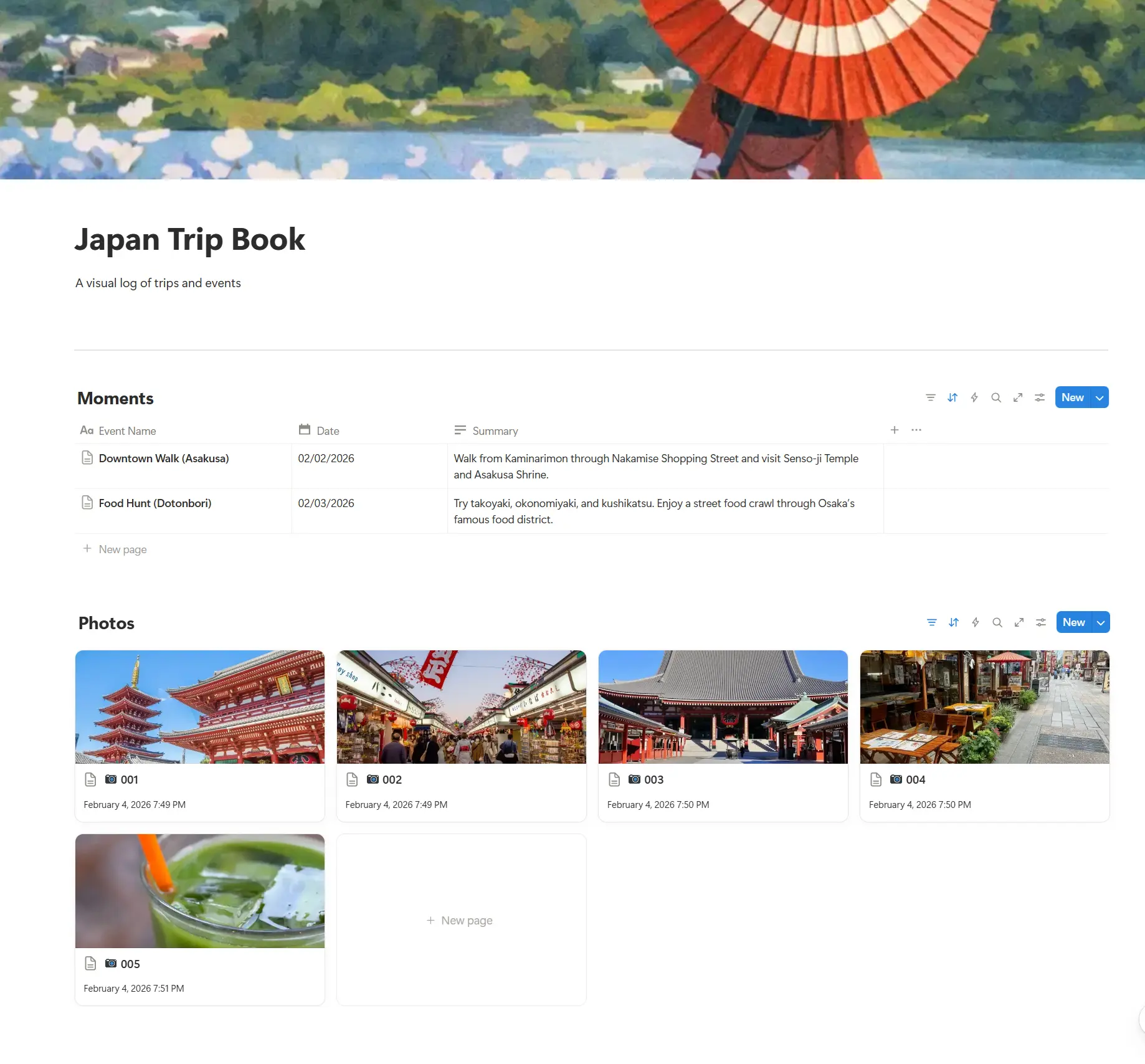
In this template, what I actually do is mostly just this:
- Create a page for each place
- Add photos
- Write one short line
Then everything lines up in chronological order.
The notes I add little by little during the trip remain as one continuous flow.
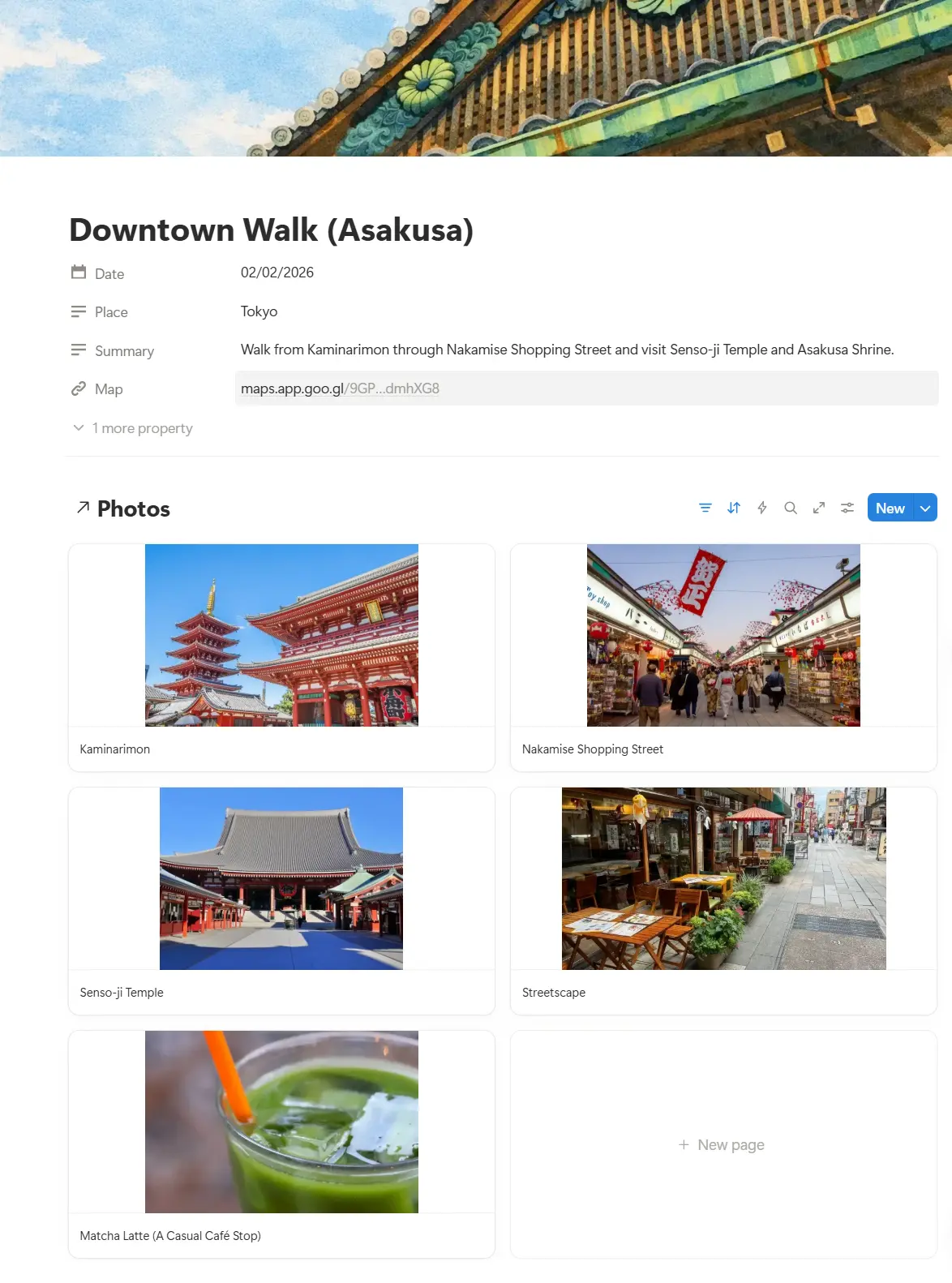

Compared to having only photos, this makes it easier to remember where I was and what I was feeling at the time.
It’s not really for posting on social media. It’s just a place to leave a few words for myself.
At least for me, when I open it later, the scenes from the trip come back naturally.
5. If You Want to Try the Same Setup
If you’d like to try using the same setup described above, I’ve prepared a template with the same structure.
It’s based on the one I actually use for my own trips, and I’ve taken the time to clean it up for this article. It’s the same one you saw in the sample image earlier.
If you have Notion, you can start using it right away.
Building something like this from scratch takes a bit of time and trial and error.
With this template, there’s no need to think up something new or build everything from zero.
Just do what I described above: add your photos and write one short line.
If you want to learn more about the template, you can find the details here:
→ Japan Trip Book – Notion Template
If you want to focus more on food experiences during your trip, you may also want to check this version:
→ Japan Trip Book: Food Hopping Edition
6. Summary
Adding just one short line to your travel photos can change how they feel when you look back at them later.
What matters is not making a perfect record, but keeping it in a form where the memories come back when you see it.